
This post may contain affiliate links. We earn a small commission if you make a purchase, at no extra cost to you. See our full disclosure.
There’s something deeply satisfying about flipping a light switch and knowing the power behind it came straight from the sun — no utility company, no monthly bill, no strings attached. If you’ve been thinking about off-grid solar power but don’t know where to start, you’re in the right place. And honestly? It’s way more accessible than most people think.
Whether you’re building a full off-grid homestead or just want a backup system that keeps the lights on when the grid goes dark, solar is the backbone of energy independence in 2026. The technology has gotten cheaper, batteries have gotten better, and the learning curve — while real — isn’t nearly as steep as it was even five years ago.
Let’s break it all down.
How an Off-Grid Solar System Actually Works
Before you spend a dime, you need to understand what’s happening between that panel on your roof and the coffee maker on your counter. It’s not complicated, but each piece matters.
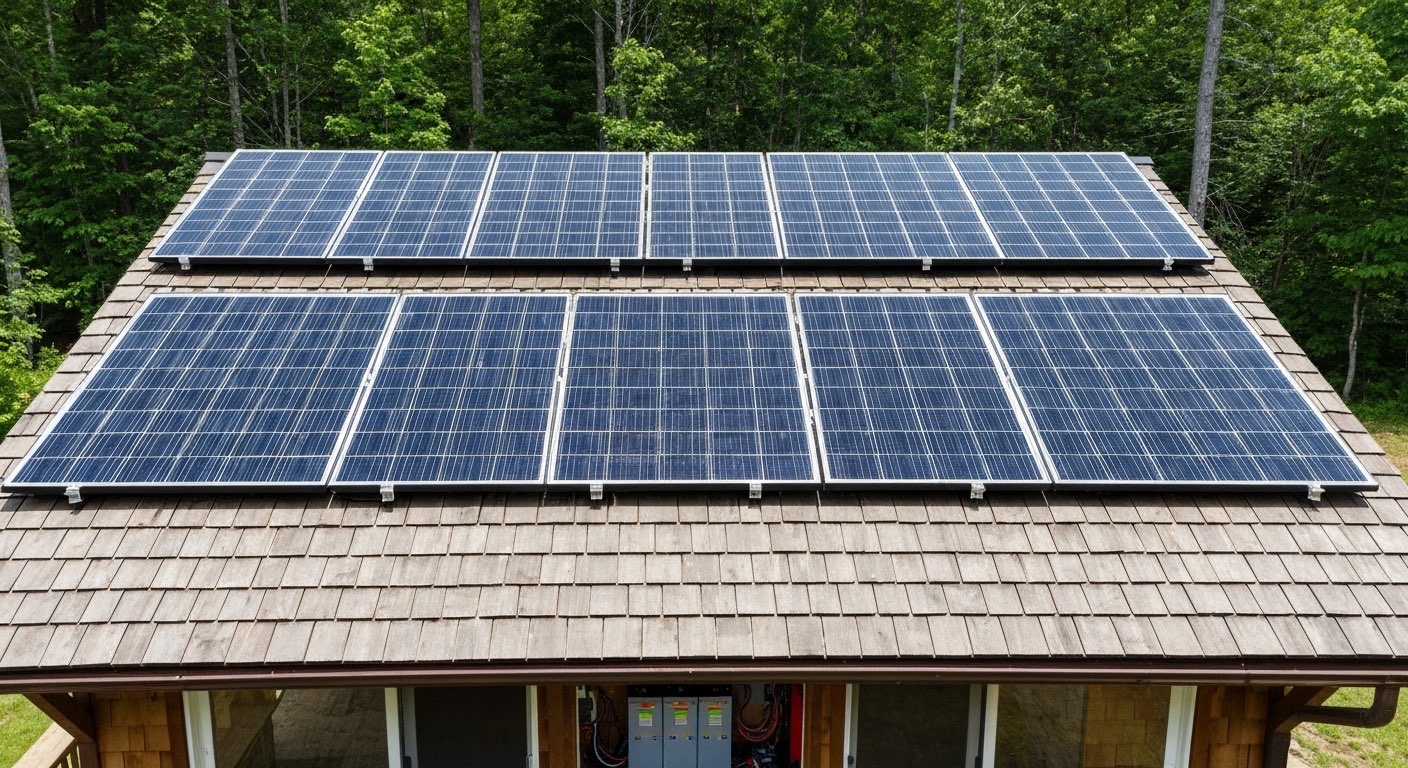
Here’s the chain: Solar panels capture sunlight and convert it into DC (direct current) electricity. That DC power flows into a charge controller, which regulates the voltage and current going into your battery bank. The batteries store your energy for when the sun isn’t shining — night, cloudy days, or that stretch in February where you swear the sun has abandoned you entirely. When you actually want to use that power, an inverter converts the stored DC electricity into AC (alternating current), which is what your appliances, lights, and outlets run on.
Panels → charge controller → batteries → inverter → your stuff.
That’s it. Four main components. Everything else is wiring, mounting hardware, breakers, and fuses (all important, but not conceptually hard). Once you grasp this flow, the rest of the decisions become a lot easier to make.
Sizing Your System: How Much Solar Do You Actually Need?
This is where most beginners either overthink things or wildly underestimate. Both mistakes are expensive.
The process starts with one question: how much electricity do you use in a day? Not how much your utility bill says — how many actual watt-hours (Wh) your appliances consume. You’ll want to make a list. Every light, every appliance, every phone charger.
Here’s a quick example. Say you run:
- LED lights (5 bulbs × 10W × 5 hours) = 250 Wh
- Refrigerator (runs about 8 hours/day at 150W) = 1,200 Wh
- Laptop (60W × 4 hours) = 240 Wh
- Phone charging (10W × 3 hours) = 30 Wh
- Water pump (250W × 1 hour) = 250 Wh
- Miscellaneous (fans, radio, small loads) = 300 Wh
Total: roughly 2,270 Wh per day — call it 2,300 Wh to give yourself a buffer.
Now, divide that by your peak sun hours. This varies wildly depending on where you live. Arizona gets 6–7 peak sun hours. The Pacific Northwest? Maybe 3–4. A good rule of thumb for most of the continental US is around 4–5 hours.
So: 2,300 Wh ÷ 4.5 peak sun hours = roughly 511 watts of solar panels. Round up to 600W to account for inefficiencies, cloudy days, and panel degradation over time. That’s a pretty modest system — maybe three or four 200W panels on your roof.
Could you get by on less? Sure, if you’re ruthless about conservation. Could you need more? Absolutely — especially if you want to run a well pump, washing machine, or (heaven forbid) an air conditioner. The math is the same either way. Start with your load, work backward.
Choosing Solar Panels: Mono vs. Poly and What Actually Matters
Walk into any solar discussion online and you’ll immediately hit the monocrystalline vs. polycrystalline debate. Here’s the short version: mono panels are more efficient and cost a bit more; poly panels are slightly less efficient but cheaper per watt.
In 2026, monocrystalline has basically won. The price gap has shrunk so much that the efficiency advantage (typically 20–22% for mono vs. 15–17% for poly) makes mono the obvious choice for most off-gridders. You get more power from less roof space. And when you’re mounting panels on a cabin, shed, or ground rack, every square foot counts.
What matters more than the mono/poly question:
- Wattage per panel — 200W to 400W panels are standard for residential off-grid. Bigger panels mean fewer connections and less mounting hardware.
- Voltage — Pay attention to the Vmp (voltage at maximum power). This determines how you string panels together and what charge controller you’ll need.
- Build quality and warranty — Look for 25-year performance warranties. Brands like Renogy, Rich Solar, and BougeRV are popular in the off-grid community for a reason: decent quality, reasonable prices, and they actually honor their warranties.
- Temperature coefficient — Panels lose efficiency when they get hot. A lower temperature coefficient means better performance on scorching summer days.
Don’t chase the absolute cheapest panels on Amazon. But don’t overpay for premium residential panels designed for grid-tied McMansions, either. The sweet spot for off-grid is solidly in the mid-range.
Battery Storage: The Heart of Your Off-Grid Solar System
Your panels are the lungs. Your batteries are the heart. Without good storage, all that beautiful solar energy just… disappears when the sun goes down.
Two main choices here: lithium iron phosphate (LiFePO4) and lead-acid (including AGM and flooded variants).
Lead-Acid Batteries
The old guard. Cheaper upfront — you can build a decent 48V lead-acid bank for $800–$1,200. But here’s the catch: you can only use about 50% of their rated capacity without damaging them. They last 3–5 years with good care (maybe 500–800 cycles). They’re heavy, need ventilation (flooded types produce hydrogen gas), and require periodic maintenance.
For a tight budget or a weekend cabin? They work fine. For a full-time off-grid home? You’ll probably replace them twice in the time a lithium bank lasts once.
LiFePO4 Batteries
The new standard. More expensive upfront — a quality 48V, 100Ah LiFePO4 battery runs $500–$900 in 2026 (prices have dropped dramatically). But you can discharge them to 80–90% of capacity without damage. They last 3,000–5,000+ cycles (that’s 8–10 years of daily use, sometimes more). They’re lighter, maintenance-free, and don’t off-gas.
When you do the math on cost-per-cycle, lithium wins by a landslide. It’s not even close.
Our recommendation: If you can swing the upfront cost, go LiFePO4. The 48V server rack style batteries (like those from EG4, SOK, or Ampere Time) offer incredible value for whole-home off-grid setups. Budget builders can start with one or two batteries and expand later — most lithium setups are modular.
Charge Controllers: PWM vs. MPPT
The charge controller sits between your panels and batteries, preventing overcharging and regulating power flow. You’ve got two types, and the difference actually matters.
PWM (Pulse Width Modulation) controllers are simple and cheap ($20–$60 for small systems). They work by essentially matching the panel voltage to the battery voltage. The downside? You lose a lot of potential energy in the process. They’re fine for tiny systems — think a single panel charging a 12V battery for an RV or small shed.
MPPT (Maximum Power Point Tracking) controllers are smarter. They constantly adjust to extract the maximum possible power from your panels, even as conditions change throughout the day. This typically gives you 20–30% more energy harvest compared to PWM. For any serious off-grid setup — anything over 400W of panels — MPPT is the only sensible choice.
Good MPPT controllers from Renogy or Victron run $150–$400 depending on amperage. Worth every penny.
One tip most guides skip: make sure your charge controller’s voltage rating matches your panel string voltage. Wire your panels in series to increase voltage (which reduces amperage and allows thinner wire runs), but don’t exceed the controller’s maximum input voltage. This is probably the most common wiring mistake beginners make, and it can fry a controller instantly.
Inverters: Turning Battery Power Into Usable Electricity
Your inverter converts DC from the batteries into the AC that runs your home. Two main types here, and this one’s non-negotiable for most people:
Pure sine wave inverters produce clean, smooth AC power identical to what comes from the grid. Every modern appliance, electronics, and motor-driven device runs properly on pure sine wave. This is what you want.
Modified sine wave inverters are cheaper but produce a choppy approximation of AC power. Some things work fine on them — simple resistive loads like incandescent bulbs or basic heaters. But they can damage sensitive electronics, make motors run hot, and create an annoying buzz in audio equipment. For a full-time off-grid home, don’t even consider modified sine wave. For a hunting cabin where you’re charging a phone and running a light? Maybe.
Sizing your inverter: look at the maximum wattage you’ll ever run simultaneously. If your biggest load moment is running a microwave (1,200W), a fridge (150W), and some lights (50W) at the same time, you need at least a 1,400W inverter. Practically speaking, a 3,000W pure sine wave inverter gives most off-grid homes comfortable headroom without being overkill.
Many off-gridders now use all-in-one inverter/charger units (like the popular EG4 or Growatt models) that combine the inverter, charge controller, and transfer switch into a single box. They simplify wiring significantly and are a great choice for beginners.
🌿 Going Off-Grid? Don’t Forget Water.
Solar handles your electricity — but what about water independence? Especially if you’re homesteading in a dry climate, having a reliable water source is just as critical as power. The Air Fountain system uses solar-compatible technology to generate water from the air around you — no well, no city hookup required. It pairs perfectly with an off-grid solar setup.
Real Costs: What a Starter Off-Grid Solar System Costs in 2026
Let’s talk numbers. Real numbers, not the fantasy figures you see in clickbait articles.
For a modest off-grid system powering a small home or cabin (2,000–3,000 Wh/day), here’s what you’re looking at:
- Solar panels (600W–800W): $400–$700
- MPPT charge controller (40A–60A): $150–$350
- Battery bank (LiFePO4, 5kWh usable): $1,000–$2,000
- Inverter (3,000W pure sine wave): $300–$800
- Mounting hardware, wiring, breakers, fuses: $200–$400
Total: roughly $2,050–$4,250
That’s a functioning off-grid solar system for less than many people spend on a used car. And once it’s paid off? Your electricity is essentially free for the next decade. The batteries might need replacing in 8–10 years, and the panels will keep producing for 25+ years (at gradually decreasing efficiency).
Want a bigger system for a full-size home with more appliances? Double or triple those numbers. A whole-home off-grid setup with 2,000W+ of panels, 10–15kWh of lithium storage, and a beefy inverter/charger typically runs $6,000–$12,000 DIY. Still cheaper than many single-year utility bills in some states.
The key word there is DIY. Hiring a professional installer can double or triple the cost. But the beauty of off-grid solar (unlike grid-tied systems) is that you can absolutely do it yourself with basic electrical knowledge and a willingness to learn. No permits required in most rural areas for off-grid systems — though always check your local codes.
🌾 Level Up Your Self-Sufficiency
If you’re serious about building a productive, self-reliant homestead — not just energy independence, but food production, land management, and regenerative farming — check out Joel Salatin’s Farm Like a Lunatic course. Salatin’s been doing this longer than most of us have been alive, and his methods actually work on real land with real constraints. Pair his farming wisdom with a solid solar setup and you’ve got a homestead that practically runs itself.
Common Mistakes Beginners Make (and How to Avoid Them)
After seeing hundreds of off-grid builds — and making plenty of mistakes on my own — here are the ones that keep popping up:
1. Undersizing the battery bank. People buy plenty of panels but skimp on storage. Your panels are useless after sunset if you don’t have enough batteries to carry you through the night (and the next cloudy day, and the one after that). Plan for at least 2–3 days of autonomy.
2. Ignoring wire sizing. Undersized wires create voltage drop, heat buildup, and fire risk. DC systems run at low voltage and high amperage, which means you need thicker wires than you’d expect. Use a voltage drop calculator. Every. Single. Time. This isn’t where you cut corners.
3. Not accounting for seasonal variation. Your panels might produce beautifully in July. But what about December, when you get half the sun hours and shorter days? Size your system for the worst month you’ll need it, not the best.
4. Forgetting about phantom loads. That TV on standby? The inverter running 24/7 with nothing plugged in? The WiFi router you never turn off? These phantom loads add up to hundreds of watt-hours per day. An off-grid home needs to be intentional about every watt.
5. Buying cheap components in the wrong places. Cheap panels? Usually fine — they all use the same cells. Cheap charge controllers or inverters? That’s where fires start. Spend your money on quality charge controllers, inverters, and wiring components. This is your home’s electrical system. Treat it that way.
6. No system monitoring. Flying blind with an off-grid system is asking for trouble. A basic battery monitor (like the Victron BMV-712 or even a cheap shunt-based voltmeter) tells you your state of charge, consumption rate, and charging performance. You can’t manage what you can’t measure.
7. Skipping the disconnect switches and fuses. Every component in your system should have a way to be isolated and protected. A short circuit in an unprotected DC system can deliver hundreds of amps instantly — enough to melt wires and start fires in seconds. Fuses are cheap. House fires are not.
Making It All Work Together
Here’s what a realistic beginner off-grid solar journey looks like:
Start by tracking your energy use for a week or two. Be honest — write down every appliance, every light, every gadget. Calculate your daily watt-hours. Then size your system with a healthy buffer (20–30% above your calculated need).
Buy quality components from reputable suppliers. Install your mounting system, wire your panels in the configuration that matches your charge controller’s specs, connect everything with properly sized cables and appropriate fusing. Commission the system, monitor it closely for the first few weeks, and adjust your habits as needed.
You will learn to be more conscious about energy. That’s not a bug — it’s a feature. Off-grid living teaches you to respect electricity in a way that grid-connected life never does. And honestly? Most people find they need far less power than they thought once they start paying attention.
If you’re building out a full homestead, solar is just one piece of the self-sufficiency puzzle. Pair it with essential homesteading skills, a productive garden, maybe some backyard chickens, and a good water strategy — and you’ve got yourself a life that doesn’t depend on anyone else’s infrastructure.
💧 Complete Your Off-Grid Setup
Energy independence is step one. Water independence is step two. The Air Fountain guide shows you how to produce clean drinking water using a simple, solar-powered device — even in areas with no well or municipal water access. It’s the perfect companion project after getting your solar system dialed in.
If you’re ready to start building your off-grid solar setup, these are the components we trust:
• Renogy 100W Monocrystalline Solar Panel — Reliable, well-priced, and one of the most popular panels for off-grid builds.
• Renogy Wanderer 30A MPPT Charge Controller — Solid entry-level MPPT that won’t leave money on the table.
• Jackery Explorer 300 Portable Power Station — Perfect for a quick plug-and-play solar backup before committing to a full system.
Recommended Resources and Next Steps
Ready to go deeper? Here are the resources that actually help:
- Books: The Solar Electricity Handbook by Michael Boxwell is updated annually and is the best beginner reference out there. Photovoltaic Design and Installation for Dummies is also solid despite the cringe title.
- YouTube: Will Prowse’s channel is the gold standard for off-grid solar reviews and education. No fluff, just honest testing and clear explanations.
- Forums: The DIY Solar Power Forum (diysolarforum.com) is where serious off-gridders hang out. Incredibly helpful community.
- Tools: PVWatts (from NREL) helps you estimate solar production for your exact location. Invaluable for system sizing.
- Our guides: Check out our complete off-grid living guide for the bigger picture — water, shelter, food, and more.
Off-grid solar power isn’t just about saving money (though it does that). It’s about resilience. It’s about knowing that when the grid goes down — and it will, eventually — your lights stay on, your food stays cold, and your family stays comfortable. That kind of security is worth every hour of research and every dollar invested.
Start small if you need to. A single panel, a battery, and a small inverter can power the essentials. You can always expand later. The important thing is to start.
The sun is free. Might as well use it.