
This post may contain affiliate links. We earn a small commission if you make a purchase, at no extra cost to you. See our full disclosure.
For most people, the decision to go off-grid isn’t some dramatic epiphany on a mountaintop. It’s sitting in rush hour traffic — 47 minutes to go 11 miles — staring at a $412 electric bill on a phone screen while the water heater at home breaks again. And something just… snaps.
Not in a bad way. More like clarity.
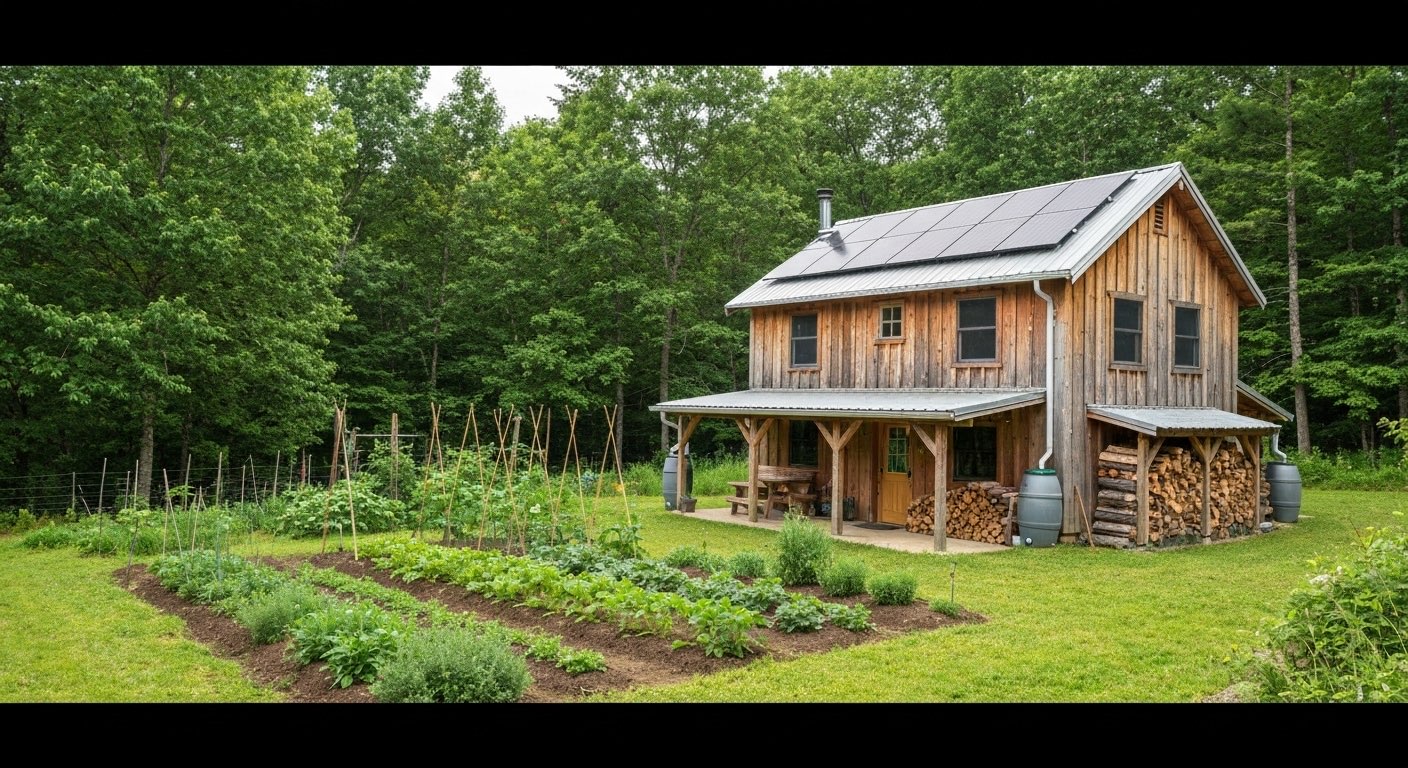
A well-built off-grid homestead runs on solar, rainwater, and a whole lot of stubbornness. Families doing it well grow half or more of their own food. Electric bill? Zero. Water bill? Also zero. And that commute? Thirty feet to the workshop.
Look — I’m not going to sugarcoat this. Off-grid living is hard. Really hard, sometimes. Talk to anyone who’s done it and you’ll hear about nights of questioning everything and mornings of wanting to call it quits. This guide is everything most people wish someone had handed them before they started.
Whether you’re dreaming about a full off-grid homestead or just want to become more self-sufficient where you are right now, this is the real deal. No fluffy Pinterest fantasies. Just what actually works.
What Does Off-Grid Living Actually Mean in 2026?
Here’s the thing — “off-grid” doesn’t mean one thing. It’s a spectrum.
Some folks picture a log cabin in Alaska with no electricity. And yeah, that exists. But most off-gridders I know (myself included) are somewhere in the middle. We use solar panels. We have internet — satellite, usually. Some of us even have Netflix. The horror.
At its core, off-grid living means disconnecting from municipal utilities and producing what you need yourself. Electricity, water, heat, food. The degree to which you do that? Totally up to you.
The Spectrum of Self-Sufficiency
I think of it as three levels:
Level 1: Urban Self-Reliance. You’re still on the grid but reducing dependence. Container gardens, solar panels on your roof, rainwater collection where it’s legal, food preservation skills. This is where most people should start, honestly.
Level 2: Rural Hybrid. You’ve got land — maybe 5-20 acres. You produce most of your own food and energy, but you might still have a grid connection as backup. A well instead of city water. Maybe you keep livestock. This is where many families spend their first couple of years.
Level 3: Full Off-Grid. Complete disconnection. You generate all your own power, collect or source your own water, grow or raise most of your food. This takes serious planning, real skills, and — let’s be honest — a decent chunk of change upfront.
None of these is “better” than the others. The best level is the one you can actually sustain.
How to Start Living Off-Grid: The Foundation Skills
Before you buy land. Before you pick out solar panels. Before you even think about chickens. You need skills.
I wrote a detailed breakdown of the 25 essential skills every homesteader needs to master, and I’d seriously recommend reading that if you haven’t yet. But here’s the cliff notes version for off-grid specifically.
The Non-Negotiable Skills for Off-Grid Living
Basic construction and repair. You will fix things constantly. Roofing, plumbing, fencing, framing — if you can’t do it yourself, you’re going to burn through money fast. Most off-gridders learn their carpentry from YouTube and a neighbor who’s been building things since 1974. Get yourself a neighbor like that.
Water management. Finding it, purifying it, storing it, not wasting it. This is arguably the single most important skill on this list. More on this below.
Food production and preservation. Growing a garden is one thing. Feeding your family year-round from that garden? Completely different ball game. You need to understand canning, dehydrating, fermenting, root cellaring, and crop rotation at minimum.
Energy systems. Even a basic understanding of 12V electrical systems, battery banks, and solar panel wiring will save you thousands. Fry one charge controller because you didn’t understand amperage, and you’ve learned a $200 lesson.
Animal husbandry. If you’re planning on livestock — and you probably should be — you need to know what you’re doing before you bring animals home. They don’t come with a pause button.
First aid and basic medical knowledge. When the nearest hospital is 45 minutes away, you need to handle the small stuff yourself. Stitches, burns, sprains, infections. We keep a well-stocked medical kit and I’ve had to use it more times than I’d like to admit.
📚 Recommended: The Lost Ways
Most of the “survival” content online barely scratches the surface. The Lost Ways is different — it’s a collection of forgotten pioneer skills, from building long-lasting food caches to constructing shelters that our great-grandparents used daily. It’s worth keeping a printed copy on your shelf. If you’re serious about self-sufficiency, this is the most comprehensive resource I’ve found.
Off-Grid Water: Your Most Critical Resource
Let me tell you something that every off-grid guide glosses over: water is everything. You can go weeks without food. You can survive without electricity. But without clean water? Three days, tops.
A single drought summer is a wake-up call: the well drops 12 feet, the rainwater cisterns run bone dry, and suddenly you’re hauling water from a creek half a mile away and purifying it with a Berkey filter. Not fun. Not sustainable.
How to Secure Your Off-Grid Water Supply
You need redundancy. Multiple sources. Because any single source can fail.
Well water is the gold standard if your land has good groundwater. A typical residential well runs 100-300 feet, and drilling one commonly lands in the $5,000-$12,000 range depending on region and depth. Owners consistently call it worth every penny. But wells can go dry, pumps can break, and you need power to run them.
Rainwater harvesting is your secondary system. A solid setup runs about 2,200 gallons of storage capacity across a few tanks connected to roof gutters. Even a single 100-gallon collapsible rain barrel is a solid start. In a good month, a system like that collects 3,000+ gallons. In a drought month? Maybe 200. That’s why you need capacity.
Surface water — creeks, springs, ponds — is your tertiary backup. Never drink it unpurified. Never. I don’t care how clear it looks.
Atmospheric water generation is the newest frontier, and it’s actually pretty fascinating. Devices that pull moisture from the air itself. I’ve been looking into the Air Fountain system — it’s a DIY approach to generating water from humidity, which could be a game-changer as a supplemental source, especially in humid climates.
We’ll be publishing a deep-dive on how to purify water in any emergency soon — bookmark that page because water purification methods are something everyone needs to understand, whether you’re off-grid or not.
Off-Grid Power Systems: Solar, Wind, and Beyond
Alright, let’s talk electricity. Because you’re going to want it. Trust me.
Plenty of families spend their first week off-grid with no power system set up yet — just candles and headlamps. By day three, most are ready to move back to the suburbs. Humans adapt to a lot of things. Total darkness at 6 PM isn’t one of them.
Solar Power for Off-Grid Homesteads
Solar is king for off-grid power. Period. It’s gotten ridiculously affordable — panels that cost $3/watt in 2010 are now under $0.30/watt — brands like Renogy have made solar accessible to everyone. Our 5.4kW system with a 48V LiFePO4 battery bank cost about $12,000 installed (we did most of the labor ourselves). It powers everything: lights, fridge, freezer, well pump, washing machine, workshop tools.
A few hard-learned truths about solar:
You need more battery capacity than you think. Seriously. Whatever number you calculated, add 30%. Three cloudy days in December can nearly drain a battery bank that looked fine on paper. Keep two days of reserve capacity as a minimum.
Orientation matters more than wattage. A perfectly-aimed 4kW system will outperform a poorly-placed 6kW system. Due south (in the Northern Hemisphere), 30-35° tilt. Don’t let trees shade your panels — even partial shade kills output disproportionately.
Inverter quality is where you don’t cut corners. The cheap inverters produce dirty power that’ll destroy sensitive electronics. The Victron MultiPlus has a reputation for being bulletproof across years of owner reports.
We’re working on a complete guide to off-grid solar power for beginners — stay tuned for that if solar is on your radar.
Wind and Micro-Hydro: Worth the Trouble?
Wind turbines look cool. I’ll give them that. But for most residential off-grid setups? They’re more hassle than they’re worth. The maintenance, the noise, the inconsistency. Unless you’re in a consistently windy corridor (average speeds above 12 mph), stick with solar.
Micro-hydro, on the other hand — if you have a running stream with decent flow and drop? That’s 24/7 power generation. Better than solar in many ways because it doesn’t care about clouds or nighttime. The catch: very few properties have suitable water features, and permitting can be a nightmare.
Comparing Off-Grid Living Approaches
Every situation is different, but this should help you figure out which direction makes sense for your goals and budget.
| Approach | Startup Cost | Difficulty | Best For | Self-Sufficiency Level |
|---|---|---|---|---|
| Urban Homesteading | $500 – $5,000 | Low | Beginners, renters, small lots | 15-30% |
| Rural Hybrid (Grid-Tied) | $10,000 – $40,000 | Medium | Families, cautious transitioners | 40-60% |
| Full Off-Grid Homestead | $30,000 – $100,000+ | High | Experienced homesteaders, committed | 70-90% |
| Off-Grid Tiny House/RV | $15,000 – $60,000 | Medium | Singles/couples, mobile lifestyle | 50-70% |
| Off-Grid Community | $5,000 – $30,000 (buy-in) | Medium | Social types, shared workload | 60-85% |
| Suburban Prepper Setup | $2,000 – $15,000 | Low-Medium | Emergency preparedness focus | 20-40% |
The numbers above are rough estimates — your actual costs depend hugely on your location, existing infrastructure, and how much DIY you’re willing to do. Doing your own construction, plumbing, and electrical work can save tens of thousands of dollars.
Growing Your Own Food: The Homestead Garden and Livestock
This is where off-grid living gets real. And rewarding. And exhausting. Sometimes all three before lunch.
Planning a Self-Sufficient Garden
The first year we gardened, we grew 900 pounds of tomatoes. Which sounds incredible until you realize we could only eat and preserve about 400 pounds. The rest rotted. Lesson learned: plan for what you’ll actually use.
For a family of four aiming at serious self-sufficiency, you want roughly 4,000-6,000 square feet of garden space. That sounds like a lot — and it is — but it breaks down when you think about calorie crops vs. supplemental crops.
Calorie crops (your survival foundation): Potatoes, sweet potatoes, winter squash, dry beans, corn. These are calorie-dense and store well. We dedicate about 60% of our garden space to these.
Nutrient crops (health and variety): Leafy greens, tomatoes, peppers, carrots, beets, onions, garlic. Another 30% of our space.
Perennials and fruit (the long game): Berry bushes, fruit trees, asparagus, rhubarb. These take years to establish but produce for decades. The remaining 10% — though honestly, we’ve been expanding this every year.
Livestock for the Off-Grid Homestead
Animals change everything. Seriously. Before chickens, an off-grid property tends to feel like a really intense camping trip. After chickens, it feels like a farm.
Chickens are the gateway livestock. There’s a reason for that — they’re relatively easy, incredibly productive, and even a small flock of 6-8 hens gives you more eggs than a family can eat. A common pattern: a family starts with six Rhode Island Reds, and within two years they’ve got 24 birds, a rooster nobody asked for, and a freezer full of homegrown chicken. I’m working on a comprehensive guide to raising chickens for beginners — keep an eye out for that.
After chickens, goats are the natural next step. Milk, cheese, yogurt, land clearing — they’re the Swiss Army knife of homestead animals. We keep four Nigerian Dwarf goats and they produce about 2 quarts of milk per day combined. Rich, creamy milk that makes grocery store stuff taste like white water.
Beyond that? Pigs are fantastic for meat production and turning scraps into protein. Bees give you honey, wax, and better garden pollination. Rabbits are quiet, prolific, and produce incredible fertilizer.
Off-Grid Heating and Cooking Without Utilities
This section doesn’t get enough attention in most guides. You’ll spend more time managing heat and cooking fuel than almost anything else, especially if you’re in a cold climate.
Heating Your Off-Grid Home
Wood heat is the off-grid standard. A good wood stove — we use a Jøtul F 500 — can heat 2,000+ square feet and cook on top. But here’s what nobody tells you about wood heat: the work starts in spring.
For our 1,400 square foot cabin in Zone 6, we burn about 4.5 cords of wood per winter. That’s roughly 18 trees worth. Cutting, splitting, stacking, and seasoning that wood is a year-round job. I spend maybe 30 hours in the spring and summer getting the next winter’s wood ready. It’s a workout. A good one, but still.
Passive solar design helps enormously. Our south-facing windows and thermal mass floor (stained concrete over radiant heat tubes) mean the stove doesn’t even kick on until temperatures drop below 25°F on sunny days. Design your home right and you cut your heating needs in half.
Cooking Off the Grid
We cook on a combination of:
Propane — yeah, I know, it’s not fully “off-grid.” But a 500-gallon propane tank lasts us about 14 months for cooking and backup water heating. It’s practical. Don’t let purists shame you.
Wood cookstove — we fire this up in winter when we’re heating anyway. There’s something deeply satisfying about a pot of stew simmering on a wood stove while snow falls outside. It’s also the slowest way to boil water known to man.
Solar oven — honestly, this was a game-changer for summer. A well-built parabolic solar cooker hits 350°F easily on a clear day. We bake bread in ours. Bread! From sunshine!
The Real Costs of Going Off-Grid
I want to be honest here because there’s a lot of misleading information floating around about how “cheap” off-grid living is. It can be affordable. But it’s not free, and the upfront investment is real.
What We Actually Spent (Rounded)
Land (15 acres, rural Appalachia): $47,000
Cabin construction (owner-built, 1,400 sq ft): $62,000
Solar system (5.4kW + batteries): $12,000
Well drilling and pump: $8,500
Rainwater system (tanks, gutters, filtration): $3,200
Septic system: $6,800
Tools, equipment, and fencing: $8,000
Livestock setup (coop, barn, initial animals): $4,500
Garden infrastructure (beds, irrigation, greenhouse): $3,800
Total: roughly $155,800
That’s… not nothing. But consider: no mortgage payment (we saved and paid cash over time), no electric bill, no water bill, no gas bill. Our monthly expenses are around $600-800 total — property taxes, insurance, propane, internet, and groceries we don’t grow. Compare that to the average American household spending $5,111/month. We’re saving over $50,000 a year.
The payback period? About three years for the utility savings alone. The quality of life improvement? Priceless. (Sorry, had to.)
Legal Considerations for Off-Grid Living
Here’s the unsexy part that trips people up. Zoning and building codes.
Not every place in America lets you live off-grid easily. Some counties require grid connection. Others mandate minimum house sizes that price out simple cabins. Composting toilets are illegal in some jurisdictions. Rainwater collection — believe it or not — has restrictions in certain states.
Where to Look for Off-Grid Friendly Land
The most off-grid-friendly states (as of 2026): Missouri, Tennessee, Arkansas, Arizona, Texas (rural counties), Oregon, Idaho, and parts of the Carolinas. These generally have lax building codes in rural areas, reasonable land prices, and established off-grid communities.
Before you buy anything, check with your county planning office. Ask specifically about:
- Minimum dwelling size requirements
- Septic vs. composting toilet allowances
- Rainwater collection legality
- Solar/wind installation permits
- Livestock allowances and setback requirements
- Owner-builder permits (can you build your own home?)
We spent two months researching counties before we bought our land. Boring? Absolutely. Worth it? You have no idea.
Common Off-Grid Mistakes (I Made Most of These)
Learn from my stupidity so you don’t repeat it:
Mistake #1: Starting too big. We tried to do everything the first year. Garden, chickens, goats, solar, well — all at once. We were exhausted by July and nothing was done right. Phase your projects. Year one: shelter and water. Year two: power and garden. Year three: livestock.
Mistake #2: Underestimating water needs. I calculated our water needs at 50 gallons per day. The reality was closer to 85 when you include livestock, garden irrigation, and the fact that teenagers take 20-minute showers no matter where they live.
Mistake #3: Cheap tools. I bought a $99 chainsaw. It lasted four months. The $400 Husqvarna that replaced it? Still running six years later. Buy once, cry once.
Mistake #4: No community. We tried to do it completely alone the first year. That’s dumb. Find your local homesteading community, join forums, make friends with neighbors. The knowledge exchange alone is worth its weight in gold. Our neighbor taught us more about goat care in one afternoon than any book ever did.
Mistake #5: Ignoring preservation. Growing food is only half the battle. If you can’t preserve it, it rots. Learn canning, dehydrating, fermenting, and root cellaring before you have 200 pounds of produce overwhelming your kitchen counter.
Building Your Off-Grid Knowledge Base
Here’s my honest take on learning resources. Most YouTube channels show you the highlight reel. The “look at my perfect homestead” content that makes it look easy. It’s not. You need resources that show you the unglamorous reality.
Books are still king for off-grid knowledge. The depth you get from a well-researched book blows away any YouTube video. A solid homestead library runs a few dozen books deep, but the ones worth going back to are the ones covering forgotten pioneer techniques — the stuff our great-great-grandparents knew instinctively that we’ve completely lost.
📚 Our #1 Recommended Resource: The Lost Ways
After years of off-grid living, I can honestly say The Lost Ways is the most complete collection of forgotten survival skills I’ve come across. It covers everything from building a smokehouse to making pemmican to constructing shelters that last decades — all from techniques that actual pioneers used.
What I appreciate most is that it’s practical, not theoretical. These aren’t “concepts” — they’re step-by-step instructions from people who lived this way out of necessity. My dog-eared copy sits on our kitchen shelf, and I still reference it regularly.
If you’re planning to go off-grid — or just want to be more self-sufficient — this is where I’d start.
These are products we’ve bought with our own money and use on the homestead:
• Renogy 100W Monocrystalline Solar Panel — Where our solar journey started. Reliable, affordable, and expandable.
• Jackery Explorer 300 Portable Power Station — We keep one of these charged as a backup for tools and devices. Pairs perfectly with a portable solar panel.
• 100-Gallon Collapsible Rain Barrel — Easy to set up, surprisingly durable, and a smart first step into rainwater harvesting.
• LifeStraw Personal Water Filter — Every member of our family carries one. Non-negotiable for backup water purification.
Frequently Asked Questions About Off-Grid Living
How much land do I need to live off-grid?
For basic self-sufficiency with a garden and small livestock, 5 acres is a workable minimum. We use about 8 of our 15 acres actively — garden, pasture, orchard, and the homestead itself. The rest is wooded, which gives us firewood and hunting land. If you’re only doing a garden and chickens, you could manage on 2-3 acres. If you want cattle or larger livestock, think 20+ acres minimum.
Is off-grid living legal everywhere in the US?
Short answer: no. Longer answer: it’s legal in most rural areas, but regulations vary wildly by county. Some places require grid connection for a Certificate of Occupancy. Others don’t regulate much at all. The key is researching your specific county’s building codes and zoning laws before purchasing property. States like Missouri, Tennessee, and Arkansas tend to be the most accommodating.
Can I go off-grid with a family and kids?
Absolutely. We did it with two teenagers, which might be the harder version. Kids adapt faster than adults, honestly. The biggest considerations are homeschooling vs. distance to schools, internet access for education, and making sure they still have social connections. Our kids have thrived — they’re more capable, more resilient, and more resourceful than most adults I know. Though they do complain about the Wi-Fi speed.
How much does it cost to set up an off-grid homestead?
Depends enormously on your approach. A bare-bones setup with land, a small cabin, basic solar, and a well can be done for $50,000-$75,000 in affordable areas. A comfortable, full-featured homestead like ours runs $120,000-$200,000. On the extreme end, some people get started for under $20,000 using used RVs, salvaged materials, and lots of sweat equity. The question isn’t really “how much does it cost?” — it’s “what are you willing to do yourself?”
What’s the hardest part of off-grid living?
The isolation. Not physically — I actually love the quiet. But socially, especially the first year. You go from seeing dozens of people daily to seeing… your spouse. And your goats. And your goats don’t have great opinions on current events. Building a community takes intentional effort when you’re rural. Join local groups, attend farmers’ markets, volunteer at your church or community center. Don’t underestimate how much you need people.
Your Next Steps: How to Start Your Off-Grid Journey Today
You don’t have to do this all at once. In fact, please don’t. Here’s what I’d do if I were starting from scratch:
Month 1-3: Learn. Read everything you can. Start with the essential homesteading skills guide and build from there. Pick up The Lost Ways and actually read it cover to cover. Practice skills where you are now — start a container garden, learn basic carpentry, take a first aid course.
Month 4-6: Plan. Define your version of off-grid. Research locations. Run the numbers. Visit properties. Talk to people already doing it.
Month 7-12: Execute. Buy land (or start converting where you are). Begin with water and shelter. Everything else builds on those two foundations.
Year 2+: Expand. Add power systems, gardens, livestock — one project at a time. Let each season teach you what you need next.
The path to self-sufficiency isn’t a sprint. It’s a marathon you actually enjoy running.
I started this whole journey sitting in traffic, frustrated and broke. Six years later, I’m writing this at a hand-built desk, looking out at our garden, listening to chickens arguing about something chickens argue about. The electric company doesn’t know my name. The water company doesn’t have my address. And that feeling? That’s freedom.
It’s not easy. But the best things never are.
📚 Get The Lost Ways — Your Blueprint for Self-Sufficient Living →