
This post may contain affiliate links. We earn a small commission if you make a purchase, at no extra cost to you. See our full disclosure.
Last updated: February 2026
Picture a scenario that plays out on homesteads every year: a kid steps on a rusty nail out by the barn. It goes straight through the boot. Blood everywhere. She’s screaming, someone’s on the phone with 911, and you’re standing there realizing that the nearest ER is 47 minutes away on a good day — in the middle of a snowstorm that has already dropped eight inches.
A prepared household handles it. Clean the wound, apply pressure, get the bleeding under control, assess whether the nail hit anything critical. By the time the roads are passable enough to drive to the clinic the next morning, the situation has been managed well enough that the doctor calls it “textbook wound care.”
But here’s the thing — most people don’t know any of that stuff. Without preparation, panic takes over: you make it worse, maybe try to drive through a blizzard with a bleeding kid in the backseat. The only reason a scenario like that goes okay is because somewhere along the way, somebody in the house got serious about medical preparedness at home.
This guide is the result of years of research into training options, common mistakes, and supply stocking. It’s everything we wish someone had handed us at the start of the homesteading journey, before realizing that “just call 911” isn’t always a plan you can count on.
Why Medical Preparedness at Home Isn’t Optional Anymore
I don’t care where you live. Suburbs, rural acreage, downtown apartment. Medical preparedness matters.
Here’s why I say that. The average emergency response time in the U.S. is about 7 minutes in urban areas. Sounds fine, right? But in rural counties — where a lot of us homesteaders live — that number jumps to 14 minutes. Some places, it’s over 30. And that’s assuming the roads are clear, the dispatcher has someone available, and the ambulance doesn’t get lost on your unmarked county road.
Then there’s the stuff nobody wants to think about. Grid-down scenarios. Natural disasters that overwhelm local hospitals. Pandemics — we all got a front-row education on that one. During COVID, there were stretches where people with non-emergency medical issues simply couldn’t get seen. Broken bones, infections, allergic reactions — you were basically on your own unless it was life-threatening. And even then, good luck.
The point isn’t to become a doctor. That’s not realistic and honestly, nobody’s asking you to perform surgery in your kitchen. The point is to bridge the gap. To handle what you can, stabilize what you can’t, and make smart decisions about when professional medical care is truly necessary versus when you can manage things yourself.
What Does Home Medical Preparedness Actually Look Like?
When most people hear “medical preparedness,” they picture a bunker full of surgical supplies and expired antibiotics. That’s not what we’re talking about.
Real medical preparedness breaks down into four areas. I think of them as layers, kind of like how you’d layer clothing for cold weather — each one builds on the last.
Layer 1: Knowledge and Training
This is the foundation, and honestly, it’s where most people fall short. You can stockpile all the gauze and splints you want, but if you don’t know how to properly clean a wound or recognize the signs of a concussion, those supplies are just expensive shelf decorations.
A basic Red Cross first aid course is the place to start. It costs about $90 and takes a Saturday — one of the best $90 investments in all of preparedness. From there, a Wilderness First Responder (WFR) course is a bigger commitment (about 80 hours over two weeks) but absolutely transforms how you think about emergency medicine.
You don’t have to go that far. But at minimum, everyone in your household should know:
- CPR and basic life support (the American Heart Association has affordable courses)
- How to control bleeding — tourniquets, pressure dressings, wound packing
- How to recognize shock and what to do about it
- Basic wound cleaning and closure
- When to use — and NOT use — a splint
- Signs of stroke, heart attack, and severe allergic reaction
- How to assess if someone needs professional care or if you can manage at home
That last one is huge. Triage isn’t just for battlefield medics. It’s for the parent at 2 AM trying to figure out if their kid’s cough needs an ER visit or just some honey and sleep.
Layer 2: Medical Supplies and Equipment
Your supplies should match your knowledge level. Period. I’ve seen guys spend $500 on a tactical trauma kit with chest seals and nasopharyngeal airways when they don’t even know how to properly apply a bandage. Don’t be that guy.
Start simple. Build out as your skills grow.
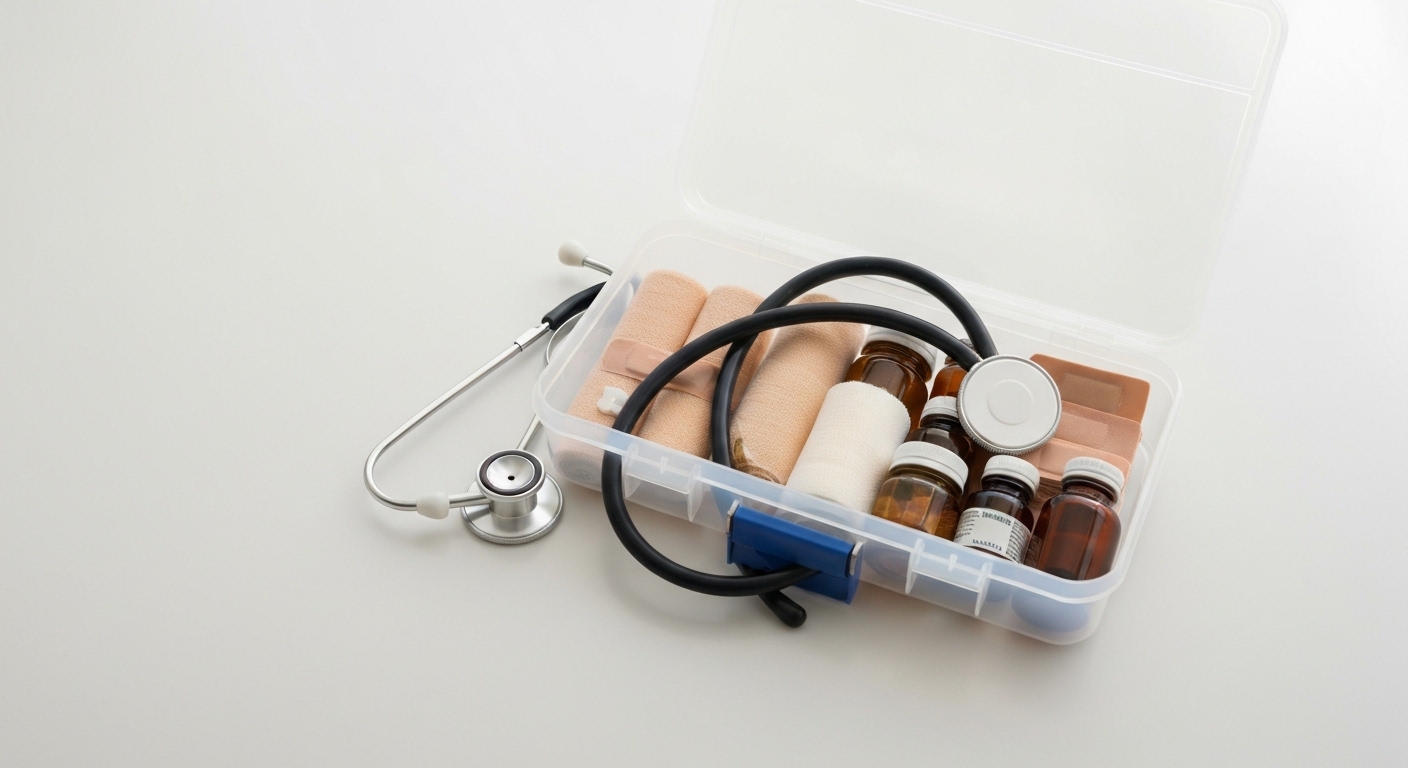
A solid home medical kit should include (at minimum):
- Assorted bandages, gauze pads, and medical tape
- Butterfly closures and/or Steri-Strips for wound closure
- Tourniquet (CAT or SOF-T — learn to use it before you need it)
- Israeli bandage or similar pressure dressing
- Antiseptic solution (povidone-iodine or chlorhexidine)
- Triple antibiotic ointment
- SAM splint (versatile, lightweight, moldable)
- Thermometer (digital, plus a non-battery backup)
- Blood pressure cuff and stethoscope
- Pulse oximeter
- Tweezers, medical scissors, and hemostats
- OTC medications: ibuprofen, acetaminophen, diphenhydramine, loperamide, antacids
- Electrolyte packets
- Nitrile gloves — lots of them
I’m putting together a full breakdown of exactly how to build an emergency medical kit from scratch — what to buy, where to get it cheap, and how to organize it so you can find what you need in the dark at 3 AM. That article is coming soon at How to Build an Emergency Medical Kit, so keep an eye out.
Layer 3: Reference Materials and Guides
Memory fails. Especially under stress. You need physical reference materials you can grab when things go sideways.
I keep three books in my medical kit: a basic first aid manual from the Red Cross, the “Where There Is No Doctor” guide (free PDF online, but I printed and laminated the key pages), and — this is the one that’s become my go-to — The Home Doctor.
📖 Recommended: The Home Doctor — Practical Medicine for Every Household
I picked this up about a year ago and it’s genuinely changed how I approach medical situations at home. Written by a doctor who practiced in Venezuela during their economic collapse — so this isn’t theoretical stuff. It’s field-tested practical medicine for when professional help isn’t available.
What I like most: it covers things other guides skip entirely. How to tell the difference between a heart attack and a panic attack. What medications you can stockpile and how to extend their shelf life. Natural alternatives for common prescriptions. How to handle dental emergencies (trust me, a toothache when you can’t get to a dentist is its own kind of hell).
It’s written for regular people, not medical professionals. Clear language, step-by-step instructions, illustrations where they matter.
Layer 4: Skills Practice and Ongoing Learning
Medical skills are perishable. That’s the phrase they use in the training community, and it’s accurate. If you learned CPR five years ago and haven’t practiced since, you’ve probably forgotten half of it. The compression rate. The ratio. The depth. It fades.
A quarterly “med drill” is worth adopting. It sounds intense but it’s really just 30 minutes practicing a scenario: one adult pretends to have a broken arm, and a teenager has to assess the injury, apply a splint, and make a call about whether outside care is needed. Kids rise to this more often than you’d expect.
We also review our medical supplies every six months. Check expiration dates, replace anything that’s been used or damaged, and update the inventory list. Sounds tedious. It is. But expired epinephrine when your kid is having an allergic reaction? That’s a nightmare I don’t want to live.
Emergency Medicine at Home: Common Scenarios and How to Handle Them
Let me walk through some real situations. Not the dramatic Hollywood stuff — the everyday emergencies that actually happen to normal people living normal (or slightly abnormal, in our case) lives.
How to Treat Deep Cuts and Lacerations at Home
This is the one you’ll deal with most. If you’re homesteading, you’re working with tools, wire, animals, and sharp objects basically all day. It’s not a question of if someone gets cut — it’s when.
The protocol I follow:
- Stop the bleeding. Direct pressure. Firm, steady pressure with a clean cloth or gauze for at least 10 minutes. Don’t peek. I know you want to — don’t.
- Assess the wound. Once bleeding is controlled, look at depth, length, location. Can you see fat, muscle, or bone? If yes — that’s an ER trip. Is it on a joint or across tension lines? Might need stitches or Steri-Strips at minimum.
- Clean it thoroughly. This matters more than most people realize. Irrigate with clean water (we use a syringe for pressure irrigation). Saline is ideal, but clean drinking water works. Get debris out.
- Close it if appropriate. Steri-Strips or butterfly bandages for smaller wounds. Anything gaping needs professional closure — or suture training, which is beyond this article.
- Dress and monitor. Clean dressing, changed daily. Watch for signs of infection: increasing redness, warmth, swelling, red streaks, or pus. Infection usually shows up 24-72 hours in.
That rusty nail scenario from the intro? Puncture wounds are actually trickier than cuts in some ways because they don’t bleed much (which means less natural flushing of bacteria) but they’re deep. Irrigate thoroughly, apply antibiotic ointment, dress it, and watch it like a hawk for three days. A tetanus booster at the clinic is usually in order, but with that care the wound itself typically heals clean.
Handling Burns When You’re Miles from the Hospital
Burns are sneaky. They look minor at first and then blister up like crazy 12 hours later.
For first and second-degree burns (red skin, blisters but intact underlying tissue): cool running water for 10-20 minutes. Not ice. Not butter. Not toothpaste. (Yes, people still try the butter thing. Please don’t.) Then aloe vera or a specialized burn cream, loose gauze dressing, and OTC pain management.
Third-degree burns — white or charred skin, no pain at the burn site (nerve damage) — that’s “get to a hospital however you can” territory. All you can do at home is cover with a clean, dry dressing and manage shock while you arrange transport.
I got a nasty second-degree burn from a wood stove two winters ago. Brushed my forearm against the pipe. Left a blister the size of a golf ball. Managed it entirely at home over about three weeks. Silver sulfadiazine cream was a game-changer for that one — worth keeping in your kit if you can get it.
When Someone Can’t Breathe: Allergic Reactions and Asthma
Nothing makes your blood run cold like watching someone struggle to breathe. Nothing.
If you have family members with known allergies, you should have multiple EpiPens — and everyone in the house should know where they are and how to use them. Practice with the trainer device. The auto-injector goes into the outer thigh, through clothing if necessary. Hold for 10 seconds. Then get to the ER, because epinephrine buys you time, it doesn’t cure the reaction.
For asthma attacks: rescue inhaler first. Sit the person upright. Calm breathing. If the inhaler isn’t working after 15-20 minutes, or if they’re turning blue around the lips, that’s a medical emergency.
It’s worth keeping diphenhydramine (Benadryl) in several rooms of the house and in every vehicle. Paranoid? Maybe. But if someone in the household has a tree nut allergy and the property is surrounded by walnut trees, seconds count when a reaction happens.
Natural Remedies as Part of Your Medical Preparedness Plan
I’m not one of those guys who thinks essential oils cure cancer. Let’s get that out of the way.
But natural remedies have a legitimate place in home medical preparedness — especially for the everyday stuff that doesn’t require pharmaceuticals. Sore throats, mild infections, digestive issues, sleep problems, minor pain. There are herbs and preparations that actually work, backed by real evidence, and they’re especially valuable when you can’t get to a pharmacy.
It helps when someone in the household takes on the herbalist role. A garden of medicinal herbs — calendula, echinacea, yarrow, plantain (the herb, not the banana), chamomile, and about a dozen others — can supply tinctures, salves, and teas for regular use.
I wrote a whole detailed piece on this: The Best Natural Remedies When You Can’t Get to a Doctor. It covers which herbs actually have evidence behind them, how to prepare them, and when to use them versus when you need conventional medicine. Worth reading if this is an area you want to explore.
The short version: natural remedies work best as your first line for minor issues, and as a supplement to conventional medicine for bigger problems. They’re not a replacement for antibiotics when you have a raging infection or for a splint when something’s broken. Use common sense.
Comparing Medical Preparedness Approaches: What Actually Works
There’s a lot of noise out there. Tactical medic courses, herbal certification programs, online video courses, comprehensive guides. How do you decide where to spend your time and money?
I’ve tried a bunch of different approaches over the years. Here’s how they stack up:
| Approach | Cost | Time Investment | Best For | Limitations |
|---|---|---|---|---|
| Red Cross First Aid Course | $90-$130 | 1 day | Absolute beginners, basic certification | Very basic; assumes quick access to EMS |
| Wilderness First Responder (WFR) | $700-$1,000 | 70-80 hours | Remote/rural households, serious preparedness | Expensive; requires significant time commitment |
| Online Video Courses (YouTube, Udemy) | Free-$50 | Variable | Supplemental learning, specific skills | No hands-on practice; quality varies wildly |
| The Home Doctor Guide | ~$37 | Self-paced reading | Comprehensive home reference, SHTF scenarios | Book-based; no hands-on component |
| Community EMT Course | $1,000-$3,000 | 120-150 hours | Those wanting formal medical training | Highest cost and time; may be overkill for most |
| Herbal Medicine / Natural Remedies | $20-$200 | Ongoing learning | Supplemental care, long-term self-reliance | Not for emergencies; requires plant knowledge |
My recommendation? Start with the Red Cross course and a solid reference guide (like The Home Doctor). That combination gives you the best return for the least investment. Then build from there based on your situation — if you’re truly remote, the WFR is worth every penny.
Building a Medical Preparedness Plan for Your Family
Okay, so you’re convinced this matters. (If you read this far, I’m guessing you are.) Now what?
Here’s the framework I use. It’s not fancy, but it works.
Step 1: Assess Your Specific Risks
Every family is different. A typical risk list might include: a kid with a nut allergy, an aging parent with heart issues who visits often, and the general hazards of running a working homestead (chainsaws, livestock, heavy equipment).
Your list will be different. Sit down and actually write it out. What chronic conditions exist in your family? What are the physical risks of your daily life? How far are you from the nearest hospital? How reliable are the roads to get there?
That assessment drives everything else.
Step 2: Get Trained — Everyone, Not Just You
This mistake is everywhere. One person becomes the “medical person” in the family — takes all the courses, reads all the books, knows all the protocols. And then one day that person is the one who gets hurt — a chainsaw kicks back and catches a leg. Nothing critical, hopefully, but now someone else has to manage the situation, and they freeze for five seconds because they’d always assumed the trained one would be doing the medical stuff.
Five seconds doesn’t sound like much. When you’re bleeding, it’s a long time.
The fix: everyone in the house over age 12 gets basic first aid training, at least one other adult takes a Stop the Bleed course, and even the youngest kids learn how to call 911 and describe symptoms. Redundancy matters in medical preparedness just like it does in every other aspect of homesteading.
Step 3: Stock Your Supplies (Intelligently)
Build your medical supplies based on your risk assessment and your training level. No point buying chest seals if you don’t know when or how to use one.
Budget tip: you can build a genuinely comprehensive home medical kit for under $150 if you shop smart. Dollar stores carry surprisingly good basic supplies. Amazon has tourniquets and Israeli bandages for a fraction of what tactical stores charge. Military surplus stores are gold mines for medical supplies.
I’ve got our full kit breakdown coming in How to Build an Emergency Medical Kit — that article will have specific product recommendations and links, plus a printable checklist.
Step 4: Create Protocols and Quick Reference Cards
Under stress, you won’t remember the steps for treating anaphylaxis. You just won’t. So we have laminated protocol cards in our medical kit. One for each major scenario: severe bleeding, burns, fractures, allergic reactions, chest pain, choking, hypothermia.
Each card has: symptoms to look for, immediate actions, when to call 911, and what to do while waiting. Simple, bullet-pointed, large font. Laminate a set and they’re honestly one of the most useful things in the entire kit.
Step 5: Practice, Review, and Update
Already covered the quarterly drills. But also: review your plan whenever your circumstances change. New family member? New medical condition? New medications? Moved to a more (or less) remote location? Update the plan.
Medications and Supplies for Long-Term Medical Preparedness
This is where things get a bit more… let’s say, debatable. Stockpiling medications is a gray area legally and medically. I’m going to tell you what I do and what I’ve learned, but I’m not a doctor and this isn’t medical advice. Use your judgment.
Over-the-Counter Medications Worth Stockpiling
These are straightforward. No prescription needed, widely available, and incredibly useful when you can’t get to a pharmacy:
- Pain/fever: Ibuprofen, acetaminophen, aspirin (aspirin doubles as a heart attack first-response medication)
- Allergy: Diphenhydramine (Benadryl), cetirizine (Zyrtec), loratadine (Claritin)
- Digestive: Loperamide (Imodium), bismuth subsalicylate (Pepto), omeprazole
- Respiratory: Guaifenesin (expectorant), dextromethorphan (cough suppressant)
- Topical: Hydrocortisone cream, triple antibiotic ointment, antifungal cream
- Other: Oral rehydration salts, glucose tablets, melatonin
Buy generic. Rotate stock (first in, first out). Most OTC meds last well beyond their expiration date — studies on military stockpiles have shown that most medications retain 90%+ potency for years past expiration — but they do eventually degrade. I keep about a 12-month supply of everything listed above.
What About Prescription Medications?
If anyone in your family takes regular prescriptions, work with your doctor to maintain a reasonable buffer supply. Most docs are understanding about this, especially if you explain your rural location and potential for being snowed in or cut off.
Beyond that, fish antibiotics have become a hot topic in the preparedness community. I’ll just say: the information is out there, it’s a decision people make, and The Home Doctor actually covers this topic in useful detail if you want to understand the options. That’s all I’ll say about it here.
Creating a Medical Communication Plan
Something that gets overlooked constantly: how do you communicate during a medical emergency when normal channels fail?
Our setup:
- Cell phones (obviously, but they’re the first thing to fail in a disaster)
- Landline (yes, we still have one — they often work when cell towers don’t)
- Two-way radios (Baofeng UV-5R — about $25 each, programmed with local repeater frequencies)
- A physical list of emergency contacts, poison control numbers, and directions to three different hospitals (in case one is overwhelmed or inaccessible)
- Medical information cards for each family member: blood type, allergies, medications, conditions. Laminated, kept in the medical kit and copies in both vehicles
Sounds like overkill until it’s not.
Medical Preparedness for Specific Situations
Grid-Down Medical Care
No electricity changes everything. Your digital thermometer? Needs batteries. Your nebulizer for Junior’s asthma? Plugs into the wall. Even basic wound care gets harder when you can’t see what you’re doing.
Plan for it. Stock battery-powered or manual versions of critical equipment. Keep headlamps in your medical kit. If someone in your family uses an electrically-powered medical device, have a backup power plan — generator, solar charger, battery bank, whatever makes sense for your situation.
Pandemic and Infectious Disease Preparedness
We all learned lessons from 2020. Mine was this: I was medically prepared for trauma (cuts, breaks, burns) but totally unprepared for infectious disease. No N95 masks. No pulse oximeter. No isolation plan for a sick family member in a 1,400 square foot house.
Now I keep a pandemic kit separate from the general medical kit: N95 masks, disposable gowns, face shields, extra thermometers, a pulse oximeter, and a plan for isolating a sick person in our guest bedroom with a separate bathroom. We also stockpile zinc, vitamin C, vitamin D, and elderberry — not as cures, but as immune support. The science is mixed on some of those, but the downside risk is basically zero.
Medical Preparedness for Children
Kids are their own category. Dosages are different. Symptoms present differently. They can’t always tell you what’s wrong. And they are magnets for injury — every parent knows this.
Key things I’ve learned with three kids on a homestead: Keep a pediatric dosing chart in your kit (posted on the medicine cabinet too). Stock children’s formulations of basic meds. Know that fever in kids under 3 months is always an emergency. And for the love of everything — learn the Heimlich maneuver for both children and infants. Different technique, different hand placement, and you do not want to be Googling it while your toddler is choking.
Frequently Asked Questions About Medical Preparedness at Home
How much should I spend on home medical preparedness?
You can get started for under $200. A basic first aid course ($90-$130), a solid reference guide like The Home Doctor (~$37), and a starter medical kit ($30-$50 if you buy smart). From there, you can build out over time. I’ve probably spent around $800 total over five years, including courses, supplies, and reference materials. But the core — the stuff that covers 90% of situations — was that initial $200 investment.
What’s the most important medical skill to learn first?
Bleeding control. Hands down. Uncontrolled hemorrhage is the number one cause of preventable death in trauma situations. Learn to apply direct pressure, use a tourniquet, and pack a wound. The Stop the Bleed course is free in many areas and takes about two hours. If you learn nothing else, learn this.
Can I really handle medical emergencies without professional training?
You can handle more than you think, but less than you’d hope. The goal isn’t to replace medical professionals — it’s to stabilize situations, manage minor to moderate issues, and make informed decisions about when professional care is necessary. With basic training and a good reference guide, most people can competently handle about 80% of common medical issues that come up in daily life. The other 20% is where you need to know your limits and get help.
How do I know when to treat at home versus go to the hospital?
General rules I follow: If someone is struggling to breathe, bleeding uncontrollably, has chest pain, shows signs of stroke (face drooping, arm weakness, speech difficulty), has a head injury with altered consciousness, or has a broken bone that’s deformed or breaking through skin — get to the hospital. For everything else, assess and treat at home first. If things aren’t improving after 24-48 hours, or if they’re getting worse despite treatment, seek professional care. When in doubt, err on the side of going in. It’s better to feel silly at the ER than to miss something serious at home.
How should I store medications for long-term preparedness?
Cool, dark, and dry. The enemies of medication shelf life are heat, humidity, and light. I use a dedicated cabinet in our basement — temperature stays between 60-68°F year-round, no direct sunlight, and I throw in silica gel packets for moisture control. I label everything with the purchase date and expected expiration. I rotate stock every 6 months, moving older supplies forward and adding new ones to the back. And honestly? I keep a spreadsheet. Sounds nerdy. Works great.
Take Action: Start Your Medical Preparedness Journey Today
If you’ve read this far, you’re already ahead of 95% of people. Most families have a half-stocked first aid kit from Costco somewhere in a closet and call it “prepared.” You know better.
Medical preparedness isn’t a destination. It’s ongoing. You build the foundation, add layers, practice, refine. Five years in and I’m still learning, still adjusting our plan, still finding gaps I didn’t know existed.
But that first step — getting trained, getting equipped, getting a solid reference guide — that’s what separates the people who panic from the people who act. And when someone you love is bleeding, struggling to breathe, or in pain and the nearest hospital might as well be on the moon… you want to be the person who acts.
📖 Our Top Pick: The Home Doctor — Practical Medicine for Every Household
If I had to recommend just one resource for home medical preparedness, this is it. Over 300 pages of practical medical guidance written specifically for non-professionals dealing with situations where doctors aren’t available. It covers everything from treating common illnesses and injuries to managing chronic conditions without regular pharmacy access to knowing which natural remedies actually work (and which are nonsense).
We keep a copy in our medical kit and one on the nightstand. It’s been the reference we reach for more than any other.
→ Get The Home Doctor and start building your medical knowledge today
Related reading:
- The Best Natural Remedies When You Can’t Get to a Doctor
- How to Build an Emergency Medical Kit That Could Save Your Life (coming soon)
Start somewhere. Start today. Your family is counting on you — even if they don’t know it yet.