
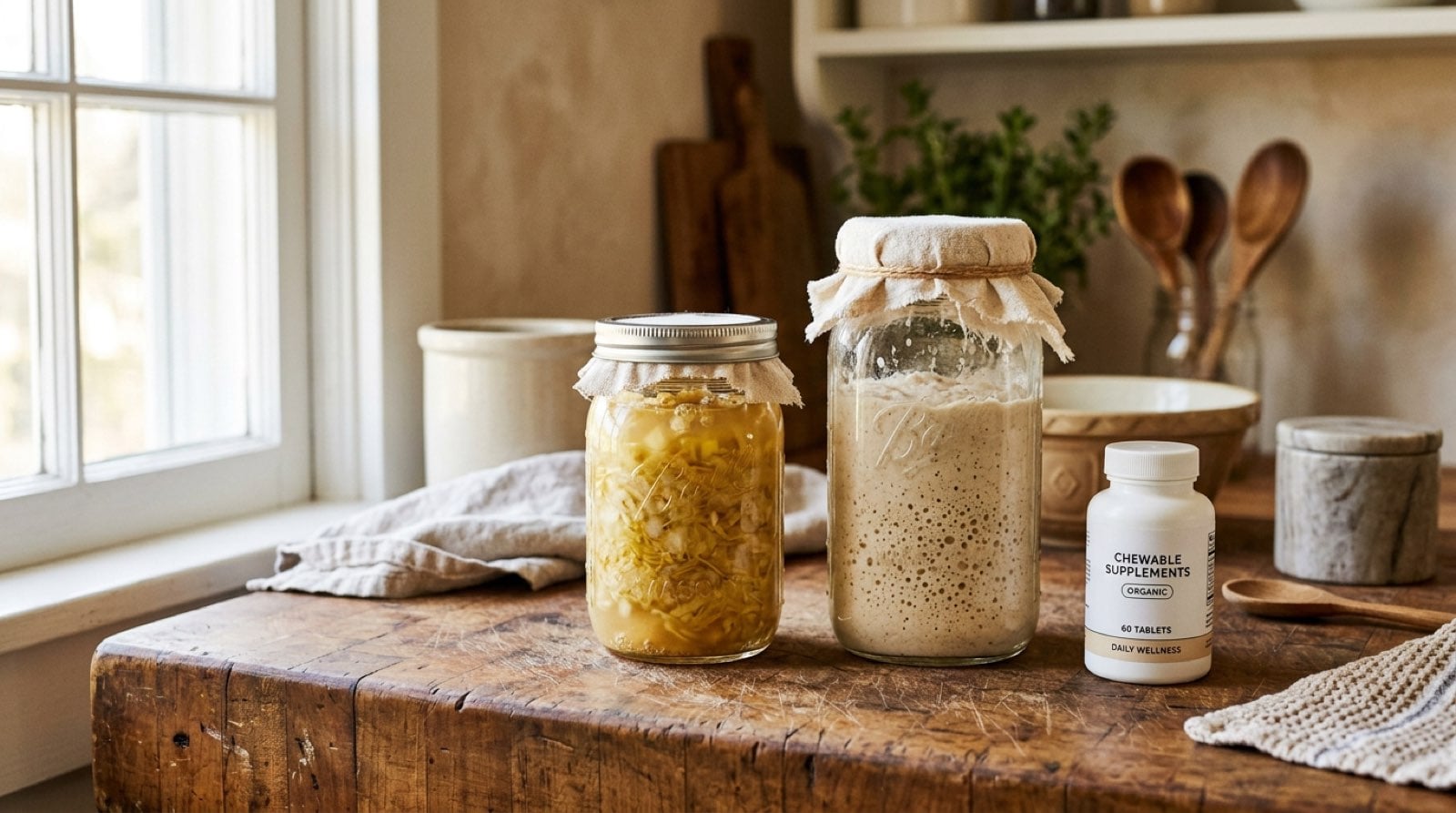
Homesteaders trust bacteria with their food, their garden soil, and their gut health — but it takes most of us embarrassingly long to realize the same logic applies to the mouth. If you keep a crock of sauerkraut going on the counter or feed a sourdough starter like it’s a member of the family, you already understand the principle behind oral probiotics. This is the guide we wish someone had handed us before spending another season buying mouthwash that made the problem worse.
Disclosure: This post contains links to a partner brand. If you purchase through our links, we may earn a commission at no extra cost to you.
How I Ended Up Researching Oral Probiotics
It started with a familiar complaint: stubborn coffee breath. You brush, you rinse with the strong blue stuff, and by mid-morning it’s back. Plenty of households do everything the drugstore aisle says to do, and it doesn’t work. Meanwhile, ten feet away on the kitchen counter, jars of ferments quietly prove a different model: you don’t fight bad biology with chemistry. You outcompete it with better biology.
That’s not a slogan — it’s how we run this whole place. We don’t sterilize our garden beds; we build living soil so the good organisms crowd out the pathogens. We don’t buy shelf-stable yogurt; we culture our own. So when I learned that the mouth has its own microbiome — hundreds of bacterial species competing for space on your teeth, gums, and tongue — the lightbulb went on fast.
Your Mouth Is a Garden, and Mouthwash Is a Flamethrower
Every homesteader learns early that you can’t sterilize your way to healthy soil. Douse a bed in harsh chemicals and yes, you’ll kill the pests — along with the earthworms, the mycorrhizal fungi, and everything else that made that soil alive. What grows back first is rarely what you wanted.
Alcohol-based mouthwash works exactly the same way. It kills the sulfur-producing bacteria behind bad breath, but it’s completely indiscriminate — it also wipes out the beneficial species that keep the troublemakers in check. A few hours later, the fastest-recolonizing bacteria move back into all that empty real estate, and they’re usually the smelly ones. So you rinse again. And again. You’ve created a dependency, not a solution.
The bacteria behind everyday bad breath produce volatile sulfur compounds — the same gases that give rotten eggs their smell. The bacteria behind enamel trouble produce acids. In a balanced mouth, friendly species keep both groups in their place. In a mouth that gets carpet-bombed twice a day, balance never gets a chance to establish.
What Oral Probiotics Actually Are
Oral probiotics are beneficial bacteria delivered in a form that dissolves in your mouth — a chewable or lozenge — so the good strains get time to attach and establish themselves on your teeth, gums, and tongue. The strains are different from gut probiotics: mouths favor species from the Streptococcus salivarius and Lactobacillus families that are adapted to oral surfaces.
Think of each daily dose as cover-cropping. One planting doesn’t transform a field, but season after season, the ground changes. Same here: most people give an oral probiotic two to four weeks of daily use before the balance meaningfully shifts, with fresher morning breath often the first thing they notice.
Can’t I Just Eat More Sauerkraut?
I asked the same thing, believe me — we have a lot of kraut. Keep eating your ferments (and if you don’t ferment yet, my fermentation crocks and kits roundup is a good place to start). But there are two honest catches:
- Wrong strains. Food ferments carry mostly gut-adapted species. They’re wonderful for digestion, but they’re not the strains that colonize teeth and gums.
- No contact time. A forkful of kraut is in and out of your mouth in seconds. Oral strains need to linger on the surfaces where the competition actually happens. That’s why a slow-dissolving chewable outperforms even the liveliest ferment for this particular job.
It’s the same reason you don’t fix a garden bed by composting a different field. Right biology, right location.
Oral Probiotics vs. Gut Probiotics vs. Mouthwash
| Oral probiotic | Gut probiotic capsule | Alcohol mouthwash | |
|---|---|---|---|
| Where it works | Teeth, gums, tongue | Intestines | Mouth (surface only) |
| Approach | Adds good bacteria to outcompete bad | Adds good bacteria to the gut | Kills everything, good and bad |
| Effect on breath | Addresses the source over weeks | Minimal — bypasses the mouth | Masks for hours, then rebound |
| Homestead equivalent | Building living soil | Composting a different field | Spraying the whole bed |
What to Look For (and What to Skip)
The supplement aisle has noticed oral probiotics are having a moment, which means there’s now plenty of junk with a nice label. Here’s my checklist, the same way I’d vet a seed company or a feed supplier:
- A form that dissolves in your mouth. Chewable or lozenge — never a swallowed capsule. A capsule spends two seconds in your mouth on the way to your stomach. It cannot colonize what it never touches.
- Named strains, in the billions of CFU. The label should tell you exactly which strains you’re getting. “Proprietary probiotic blend” is the supplement version of “farm fresh” — it means nothing.
- Mouth-specific supporting ingredients. The formulas I respect add xylitol, which supports healthy saliva pH, and hydroxyapatite — the actual mineral your enamel is built from.
- Sugar-free, clean label. Feeding sugar to your mouth bacteria while trying to rebalance them is like weeding with one hand and planting bindweed with the other.
The one we landed on after comparing labels is Bianca Bright’s Oral Probiotic Chewables — multi-strain, chewable, sugar-free, with both xylitol and hydroxyapatite in the formula. It checks every box on that list without compromise, and kids will actually take a chewable without a negotiation summit.
Want to try what we use?
Get Bianca Bright Oral Probiotic Chewables →
The Simple Routine That Worked for Us
- Night: brush like normal, then let the chewable dissolve right before bed. Saliva flow drops overnight, which gives the strains maximum undisturbed settling time — the microbial equivalent of transplanting on a still evening instead of a windy afternoon.
- Morning: brush as usual. We retired the harsh blue mouthwash entirely; if you’re not ready for that, at least keep it hours away from your probiotic dose so you’re not torching what you just planted.
- Stay consistent. Every skipped day hands ground back to the old population. Tie it to an existing habit — keep it next to the toothpaste, so nobody has to remember anything.
Owner reports consistently describe the difference in morning breath showing up somewhere in week two. By week four it’s just… not a thing anymore. That’s the honest timeline: this is gardening, not a light switch.
And to be clear about what oral probiotics are not: they don’t replace brushing, flossing, or your dentist. They’re one piece of a natural oral care approach — for the bigger picture, our homestead wellness guide puts it all in context.
Frequently Asked Questions
How long do oral probiotics take to work?
Give it two to four weeks of daily use. Early wins like fresher morning breath often show up in the first one to two weeks, but the balance shift that makes it stick takes about a month. Quitting after three days is the number one reason people say they “don’t work.”
Can I take an oral probiotic and a gut probiotic together?
Yes, and plenty of people do — capsule with breakfast, chewable after brushing at night. They work different territory and don’t conflict.
Are oral probiotics safe for kids?
The chewable format is generally kid-friendly, but check the specific product’s label for age guidance and ask your family dentist or pediatrician if you’re unsure — same as any supplement in the house.
Do I have to give up mouthwash?
You don’t have to, but understand they work against each other. If you keep a strong rinse in rotation, separate it from your probiotic dose by several hours. We dropped ours and haven’t missed it.
What happens if I stop taking them?
Nothing dramatic — the beneficial strains gradually lose ground and your mouth drifts back toward its old balance over weeks. Like most good things on a homestead, the results follow the habit.
The Bottom Line
Tend the microbiome instead of nuking it. It’s how we garden, it’s how we ferment, it’s how we handle gut health — and it turns out it’s how we ought to care for our mouths, too. If the drugstore routine has been losing the same battle every morning at your house, try switching models. Plant something better and let it compete.
Try Bianca Bright Oral Probiotic Chewables →
These statements have not been evaluated by the Food and Drug Administration. Probiotic products are not intended to diagnose, treat, cure, or prevent any disease.