
Disclosure: This post contains affiliate links. If you click through and make a purchase, we may earn a commission at no extra cost to you. We only recommend products we’ve personally reviewed and believe in. See our full affiliate disclosure for details.
Here’s a question that keeps a lot of people up at night: if the grocery stores closed tomorrow — really closed, for weeks or months — how long could your family eat?
For most Americans, the honest answer is terrifying. A few days. Maybe a week if they stretch it. We’ve built our entire lives around a system that delivers fresh food on demand, and we’ve forgotten that this convenience is historically unusual. Fragile, even.
I’m not trying to scare you. Well, maybe a little. But here’s the good news: learning how to store food long term isn’t complicated. People have been doing it for thousands of years without electricity, without vacuum sealers, without any of the fancy equipment that modern “preppers” think they need. Your great-grandparents understood this stuff instinctively. We just have to relearn it.
This guide covers everything — the methods, the containers, the shelf lives, the rotation systems, the mistakes that ruin perfectly good food. By the end, you’ll have a complete framework for building a food storage system that could sustain your family through just about anything.
Let’s dig in.
Why Long-Term Food Storage Matters (More Than Ever)
Look, I’m not a doomsday guy. I don’t have a bunker full of MREs and gas masks. But I do pay attention to what’s happening around us.
Supply chain disruptions in 2020 and 2021. Rolling shortages of random items — cream cheese one week, baby formula the next. Inflation making a trip to the grocery store feel like highway robbery. Natural disasters that knock out infrastructure for weeks at a time.
You don’t need a full-scale apocalypse to benefit from having food stored away. A job loss. A medical emergency that wipes out your savings. A bad winter storm that keeps you housebound. Long-term food storage is just… insurance. The most practical, edible insurance you can buy.
And unlike that car insurance policy you pay for every month, this one is something you can actually use. Eat it, rotate it, live off it if you need to.
The goal isn’t to stockpile a decade’s worth of freeze-dried meals in some bunker. The goal is building a buffer — three months, six months, a year — that gives you breathing room when life gets unpredictable. And life always gets unpredictable eventually.
The Enemies of Stored Food: What You’re Fighting Against
Before we talk about methods, you need to understand what actually destroys stored food. Because if you don’t address these factors, it doesn’t matter what containers you use or how much you spend. Your food will still go bad.
Oxygen. The big one. Oxygen allows aerobic bacteria and mold to grow. It causes fats to go rancid. It degrades vitamins. Most long-term storage methods are fundamentally about removing oxygen from the equation.
Moisture. Water is life — for bacteria, mold, and insects too. Dry foods stored with even a little moisture will develop problems fast. You want your storage environment under 10% humidity, ideally lower. The foods themselves should be at 10% moisture content or less.
Heat. Every 10°F increase in storage temperature roughly halves the shelf life of most foods. A basement at 60°F will preserve food dramatically longer than a garage that hits 90°F in summer. Cool and consistent beats warm and fluctuating every time.
Light. UV radiation degrades nutrients and can cause chemical changes in food. This is why proper storage containers are opaque, and why you don’t store food in glass jars on open shelves (despite how pretty it looks on Pinterest).
Pests. Insects, rodents, even your own pets if they can get into it. Proper containers and a clean storage environment are non-negotiable.
Control these five factors and your food lasts. Ignore any of them and you’re wasting your time and money.
The Best Methods for Long-Term Food Storage
Mylar Bags with Oxygen Absorbers
If I had to pick one method for a beginner — one that offers the best combination of effectiveness, affordability, and ease — it’s Mylar bags with oxygen absorbers. This is what serious food storage people use, and once you try it, you’ll understand why.
Mylar bags are essentially metallic pouches that block light and oxygen. When you combine them with oxygen absorbers (small packets containing iron powder that chemically bonds with oxygen), you create an environment where aerobic organisms simply cannot survive. No oxygen = no bacteria, no mold, no insects.
The process is straightforward:
- Buy food-grade Mylar bags (5-7 mil thickness for long-term storage — thicker is better)
- Get appropriately sized oxygen absorbers (typically 300cc absorbers for gallon-sized bags)
- Fill the bag with your dry goods, leaving a few inches at the top
- Drop in the oxygen absorber
- Seal the bag with a clothes iron or hair straightener (seriously, it works)
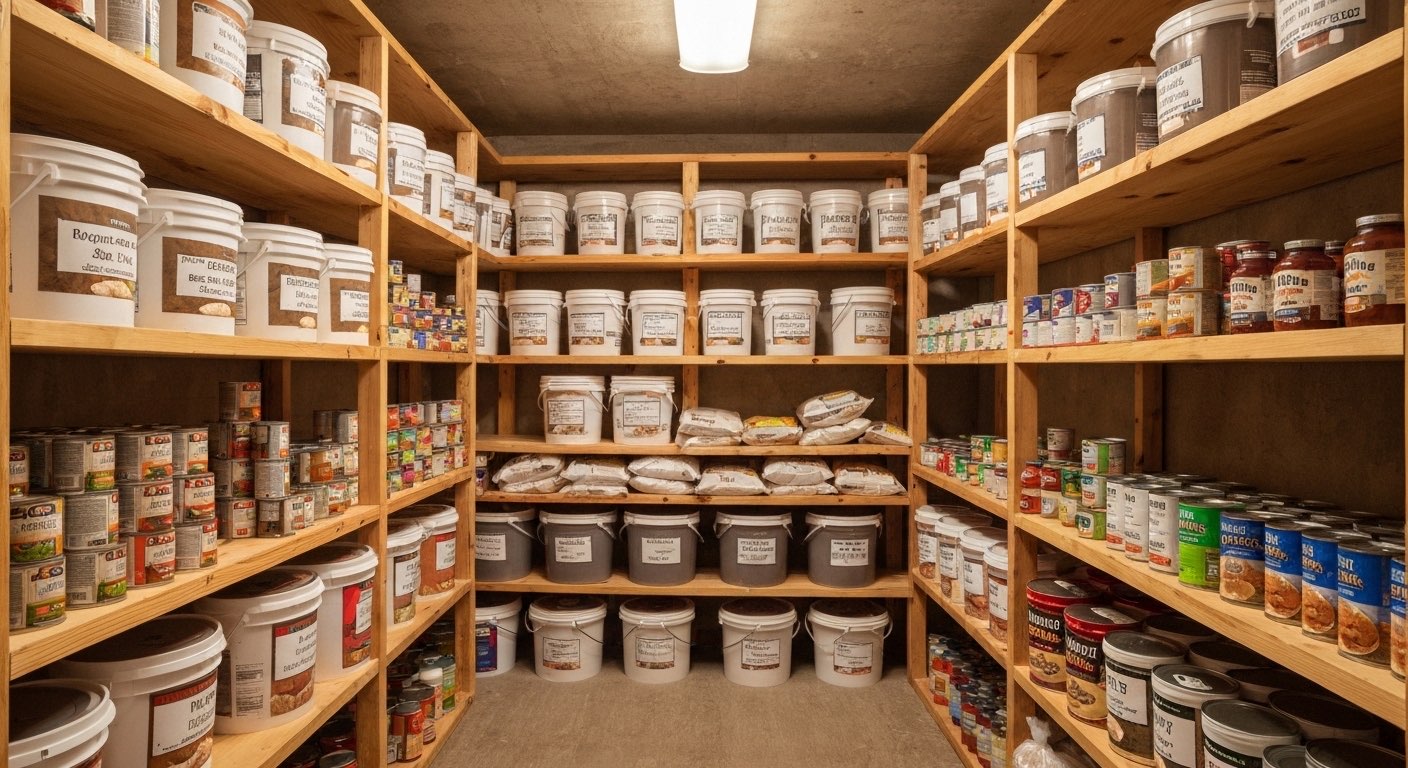
- Store the sealed bags inside food-grade buckets for extra protection
That’s it. Rice packed this way will last 25-30 years. Wheat berries, even longer. Dried beans, 20+ years. Most dry goods, properly sealed with oxygen absorbers, will outlast you.
The cost is shockingly reasonable. A pack of 100 Mylar bags with oxygen absorbers runs about $30-40 on Amazon. Add some 5-gallon food-grade buckets ($5-7 each at hardware stores, or free from bakery departments at grocery stores if you ask nicely), and you can store hundreds of pounds of food for under $100 in materials.
What to store in Mylar bags:
- White rice (brown rice has oils that go rancid — stick to white for long-term)
- Wheat berries (grinding flour as needed)
- Dried beans and lentils
- Oats (rolled or steel-cut)
- Pasta
- Sugar and salt
- Dried corn
- Powdered milk
What NOT to store in Mylar bags:
- Anything with more than 10% moisture
- High-fat foods (nuts, brown rice — they’ll go rancid even without oxygen)
- Home-dehydrated foods unless you’re certain they’re dry enough
Vacuum Sealing
Vacuum sealers have become popular because they’re easy and relatively cheap. But here’s the thing: they’re not actually great for truly long-term storage.
A standard FoodSaver-style vacuum sealer removes about 90-95% of the air. That’s great for the freezer (extending frozen food shelf life from months to years), but it’s not enough for room-temperature storage of dry goods. That remaining 5-10% of oxygen is enough to support degradation over years.
Vacuum sealing excels at:
- Preparing food for the freezer
- Medium-term pantry storage (1-3 years)
- Protecting food from moisture and pests
It falls short for:
- True multi-decade storage
- Anything you can’t freeze
My recommendation: use vacuum sealing as a complement to other methods, not a replacement. Vacuum seal portions of food, then store those sealed portions inside Mylar bags with oxygen absorbers for belt-and-suspenders protection.
Canning (Home Pressure Canning)
Canning is the old-school method your grandmother probably used, and it’s still one of the best ways to preserve certain foods — particularly anything wet or acidic.
There are two types:
Water bath canning works for high-acid foods: tomatoes, pickles, jams, fruit preserves, fermented vegetables. The acid prevents botulism bacteria from growing, so you only need to heat the jars to boiling temperature (212°F).
Pressure canning is required for low-acid foods: vegetables, meat, beans, soups, stocks. These foods need to reach 240°F+ to kill botulism spores, and the only way to achieve that temperature at normal altitudes is with a pressure canner.
Properly canned food lasts 2-5 years on the shelf, sometimes longer. I’ve eaten home-canned tomatoes that were seven years old and they were fine (though nutrition does degrade over time).
The main advantages of canning:
- You can preserve wet foods that don’t work with dry storage methods
- The food is ready to eat — no rehydration required
- It’s a skill that uses reusable equipment (jars and lids are cheap and last forever)
The disadvantages:
- Requires initial equipment investment ($100-300 for a good pressure canner)
- Time-intensive
- Shorter shelf life than properly stored dry goods
- Takes up more space per calorie than dried foods
We’ve got a full beginner’s guide to canning and food preservation if you want to go deeper on this method.
Freeze-Drying
Freeze-drying is the gold standard for preserving food quality — nutrients, flavor, texture, everything. It’s also the most expensive option by a significant margin.
The process involves freezing food to extremely low temperatures, then using a vacuum to remove the moisture through sublimation (ice turning directly to vapor, skipping the liquid phase). The result is food that retains nearly all its original nutrients and flavor, weighs almost nothing, and lasts 25-30 years when properly stored.
Commercial freeze-dried food (Mountain House, etc.) is what backpackers and preppers have relied on for decades. The quality is excellent. The prices are… not.
Home freeze-dryers have entered the market in recent years (Harvest Right is the main brand). These machines run $2,000-5,000 depending on size, which sounds insane — until you calculate that freeze-drying your own food costs roughly $1-2 per pound versus $15-25 per pound for commercial freeze-dried meals.
If you’re serious about long-term food storage and have the budget, a home freeze-dryer pays for itself over time. You can preserve everything: fruits, vegetables, dairy, meat, complete meals, even ice cream (which is disturbingly addictive in freeze-dried form).
The main barrier is cost. That’s it. If you can afford the machine, freeze-drying is objectively the best preservation method for most foods.
If you want to go deep on preservation techniques — including dozens of methods that don’t require any modern equipment — check out The Lost Superfoods. It covers 126 forgotten preservation methods, from Depression-era techniques to military hardtack that lasts over a century. I’ve tested several of the recipes myself, and the pemmican guide alone is worth the price.
Root Cellaring
Here’s a method that costs almost nothing and has worked for thousands of years: underground storage.
Root cellars leverage the earth’s natural insulation to maintain cool, stable temperatures year-round. Even in extreme climates, the soil 6-8 feet below the surface stays around 50-55°F — perfect for storing certain foods without refrigeration.
Traditional root cellar crops include:
- Potatoes (8-12 months)
- Carrots, beets, turnips (4-6 months)
- Winter squash and pumpkins (3-6 months)
- Apples (2-4 months depending on variety)
- Cabbage (3-5 months)
- Onions and garlic (6-8 months)
You don’t need a full underground cellar to benefit from this approach. A buried trash can, an unheated corner of a basement, even a well-insulated outdoor structure can provide similar conditions.
The key requirements:
- Temperature: 32-40°F is ideal (just above freezing)
- Humidity: 80-95% for root vegetables (they’ll shrivel in dry conditions)
- Darkness: light degrades stored produce
- Ventilation: some air exchange prevents mold and gas buildup
Root cellaring pairs beautifully with a survival garden. Grow crops specifically suited for long storage, then preserve them through the winter without electricity or canning equipment.
Smoking, Drying, and Traditional Preservation
Before refrigeration existed, every culture had methods for preserving food through the seasons. Many of these techniques are making a comeback because they work — and because they produce foods that taste far better than their modern industrial counterparts.
Smoking. Smoke contains natural antibacterial compounds (phenols, acids, aldehydes) that preserve food while adding flavor. Properly smoked meat and fish can last months at room temperature, years if kept cold. You can build a simple smokehouse for under $100 in materials.
Drying/Dehydrating. Remove the water and bacteria can’t grow. Simple as that. A basic electric dehydrator runs $50-100 and will last decades. Sun drying works too, if you live in an appropriate climate. Dried fruits, vegetables, jerky, and herbs store for 6-12 months at room temperature, longer if vacuum-sealed or frozen.
Salt curing. Salt draws moisture out of food and creates an environment hostile to bacterial growth. Salt pork, salt fish, and cured meats have been staples throughout human history. The technique isn’t complicated, but it requires attention to ratios and timing.
Fermentation. Lactic acid fermentation transforms food into something that actively resists spoilage. Sauerkraut, kimchi, fermented pickles — these foods don’t just last, they get better over time. Plus you’re building gut health with every bite.
These traditional methods represent generations of accumulated knowledge. They work. And in a long-term crisis scenario, they’re the methods you’d fall back on when modern conveniences aren’t available.
Want to produce your own food to preserve? Joel Salatin’s Farm Like a Lunatic course teaches the systems that let you raise meat, eggs, and produce on even a small property. He’s spent decades perfecting sustainable food production — the kind that reduces your dependence on grocery stores permanently, not just through stored supplies.
Shelf Life Reference Chart
Here’s a quick reference for properly stored foods. These assume optimal conditions: cool temperatures (60°F or below), low humidity, oxygen-free environment (Mylar bags with oxygen absorbers), and no pest contamination.
| Food | Shelf Life (Optimal Storage) |
|---|---|
| White rice | 25-30+ years |
| Wheat berries | 30+ years |
| Rolled oats | 20-25 years |
| Dried corn | 25-30 years |
| Dried beans | 20-25 years |
| White sugar | Indefinite |
| Salt | Indefinite |
| Honey | Indefinite |
| Dried pasta | 20-25 years |
| Powdered milk | 20-25 years |
| Freeze-dried meat | 25-30 years |
| Freeze-dried fruits/vegetables | 25-30 years |
| Home-canned vegetables | 2-5 years |
| Home-canned meat | 2-5 years |
| Commercially canned goods | 3-8 years |
| Jerky (properly dried) | 1-2 years |
| Dehydrated vegetables | 6-12 months (longer if vacuum-sealed) |
| Brown rice | 6-12 months (oils go rancid) |
| Nuts and seeds | 6-12 months (longer frozen) |
Important: These are conservative estimates based on optimal storage. Many foods remain safe far longer than listed, though nutritional quality continues to degrade over time.
Building Your Food Rotation System
Having food stored is only half the equation. You also need a system for using it before it degrades, and replacing what you consume. This is where most people fail.
I’ve seen preppers with basement shelves full of canned goods from 2015 — bulging cans, faded labels, food that’s almost certainly inedible. That’s not preparedness. That’s wasted money and a false sense of security.
The solution is simple: First In, First Out (FIFO).
When you add new food to your storage, it goes in the back. When you need food for daily cooking, you take from the front. The oldest food always gets used first.
This works best if you’re storing foods you actually eat. Don’t buy 50 pounds of wheat berries if you’ve never made bread in your life. Stock what you cook with. Use your storage as a working pantry, not a disaster museum.
Practical Tips for Rotation
Date everything. Write the purchase/pack date on every container with a permanent marker. Make it visible. If you have to dig around to find the date, you won’t bother.
Store at eye level what expires soonest. Put the oldest cans and packages where you can see them. New additions go on top shelves or in back corners.
Schedule inventory checks. Once per quarter, walk through your storage. Look for damage, pests, leaks, anything suspicious. Note what’s getting old and plan meals around it.
Track consumption. Nothing fancy — a whiteboard on the pantry door works fine. When you use something, note it. When you restock, cross it off. This gives you data on how fast you actually go through food.
Plan menus using storage food. Once a week or month, plan meals specifically to rotate through stored items. “Pantry challenge” weeks where you avoid buying groceries and cook exclusively from storage are great for both rotation and budget.
What Should You Store? A Practical Framework
Instead of listing specific foods (everyone’s dietary needs differ), here’s a framework for building balanced long-term storage:
The Foundation: Grains and Starches
These provide the bulk of your calories. Cheap, shelf-stable, and satisfying.
- Rice, wheat berries, oats, corn, pasta
- Target: 300+ lbs per person per year
The Protein
Harder to store long-term, but critical for nutrition.
- Dried beans and lentils (primary — cheap and long-lasting)
- Canned or freeze-dried meat (backup for when you need animal protein)
- Peanut butter, dried eggs, protein powder
- Target: 60+ lbs per person per year (not counting canned/freeze-dried)
The Fats
You need fat in your diet, and it provides dense calories.
- Coconut oil (exceptionally shelf-stable, 2+ years even after opening)
- Olive oil (1-2 years sealed)
- Shortening (2+ years)
- Butter powder/ghee
- Target: enough for 2+ tablespoons per person per day
The Vitamins (Produce)
This is the hardest category for long-term storage.
- Freeze-dried fruits and vegetables (ideal but expensive)
- Dehydrated vegetables
- Canned vegetables and fruit
- Vitamin supplements (as backup, not replacement)
- Target: 1-2 servings per person per day from stored sources
The Flavor
Food fatigue is real. After a few weeks of bland beans and rice, morale tanks.
- Salt (lots of it — for cooking AND preservation)
- Sugar, honey
- Spices (buy whole, grind as needed — last longer)
- Bouillon cubes, dried herbs
- Coffee, tea, cocoa
- Target: enough to make bland food interesting
The Supplements
Stuff that fills gaps in the above categories.
- Powdered milk
- Baking soda/powder
- Yeast (keep in freezer)
- Multivitamins
Common Mistakes (And How to Avoid Them)
After years of watching people attempt food storage — myself included — these are the mistakes I see again and again:
Storing food you don’t eat. Quinoa is great if you like quinoa. If you’ve never cooked it and don’t particularly enjoy it, why would a crisis make it taste better? Store what you already eat. Expand gradually.
Ignoring the oxygen problem. Throwing dry goods in a bucket is not long-term storage. Neither is vacuum sealing alone for multi-decade timelines. Oxygen absorbers are cheap. Use them.
Forgetting about water. You need water to cook rice. You need water to rehydrate freeze-dried food. You need water to can safely. If your water supply disappears, so does your ability to use much of your stored food. Plan accordingly — we’ve got a guide to water purification methods that covers the basics.
All eggs in one basket. Don’t keep your entire food supply in one location. If a flood/fire/tornado hits that spot, you lose everything. Split storage between multiple locations if possible.
No rotation system. Already covered this. If you’re not actively rotating your storage, you’re building a pile of future trash.
Overcomplicating it. You don’t need a commercial warehouse setup. You don’t need $10,000 in equipment. Start with 50 pounds of rice in Mylar bags. Build from there. Perfection is the enemy of progress.
Food storage is just one piece of disaster preparedness. If you want a comprehensive framework covering food, water, security, and medical basics — Alive After the Fall puts it all together. It’s particularly good on grid-down scenarios and the first 72 hours after a major event. Worth reading alongside any food storage program.
Getting Started: Your First Weekend Project
Don’t let the scope of this guide overwhelm you. Start small. One weekend, one project, and you’ll be further along than 90% of people.
This weekend, do this:
- Buy 20-25 lbs of white rice, 10 lbs of dried beans, and 5 lbs of oats from Costco or a bulk store ($30-40 total)
- Order a pack of gallon-size Mylar bags with oxygen absorbers from Amazon ($15-20)
- When the bags arrive, seal the rice, beans, and oats following the process described above
- Store in a cool, dark place
Congratulations. You now have roughly two weeks of emergency food for one person (longer if rationing), properly stored to last decades. Total cost: under $60.
Next month, double it. The month after, add variety. Before you know it, you’ll have a serious food storage system that required no single massive investment — just consistent small steps over time.
That’s the approach I recommend. The people who try to buy everything at once usually burn out or go broke. The people who build slowly, rotate consistently, and learn as they go — they’re the ones who end up genuinely prepared.
Final Thoughts
Long-term food storage isn’t about paranoia. It’s not about bunkers and doomsday scenarios. It’s about taking responsibility for yourself and your family’s security in an uncertain world.
Every generation before ours understood this instinctively. They canned the summer harvest. They stored grain through winter. They knew how to smoke meat and ferment vegetables and keep root crops from freezing. We’re the first generation to completely outsource our food security to a just-in-time supply chain — and we’re starting to realize that might have been a mistake.
The skills in this guide aren’t just for preppers. They’re fundamental life skills. They save money (buying in bulk always beats buying retail). They improve food quality (home-preserved food tastes better than commercial versions). And they provide peace of mind that no amount of Amazon Prime same-day delivery can match.
Start this weekend. Keep building. And if you want to go deeper on any of these methods — particularly the traditional preservation techniques that don’t rely on modern equipment — check out our guide to building a 6-month emergency food supply and our full emergency food preparedness guide for the complete framework.
You’ve got this.
Have questions about food storage? Drop them in the comments. I read every one and respond when I can.
Disclosure: This post contains affiliate links. We earn a small commission if you make a purchase, at no extra cost to you. See our full affiliate disclosure.