
Disclosure: As an Amazon Associate, I earn from qualifying purchases. Links below may be affiliate links. Thank you for supporting Homestead Fanatic!
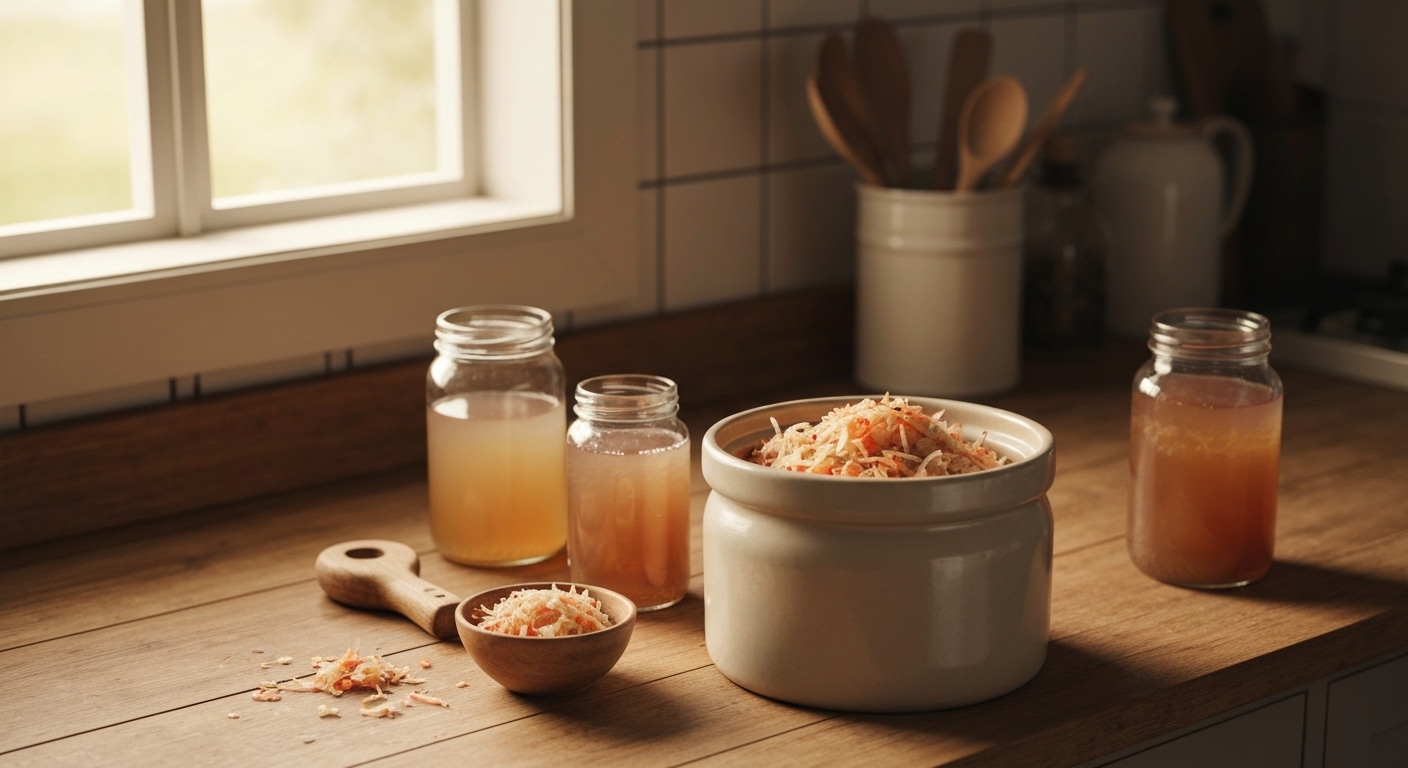
There’s something deeply satisfying about opening a crock of homemade sauerkraut you packed six weeks ago. That tangy, probiotic-rich crunch. The knowledge that you preserved cabbage using nothing but salt and time—the same technique humans have used for thousands of years.
Fermentation is having a moment, and for good reason. It’s cheap, it’s healthy, and it transforms ordinary vegetables into something extraordinary. But here’s what the trendy fermentation blogs don’t always tell you: your container matters. A lot.
The wrong vessel leads to mold, off-flavors, and wasted produce. The right one creates an anaerobic environment where beneficial lactobacillus bacteria thrive while harmful organisms can’t survive. We’ve fermented hundreds of batches in everything from Mason jars to traditional German crocks, and the difference in results is dramatic.
Quick Navigation:
- Top Pick: Humble House Sauerkrock
- Best Traditional: Ohio Stoneware Crock
- Best Starter Kit: Masontops Complete Kit
Why Trust Our Recommendations
We’re homesteaders who ferment year-round—not just a batch of kraut when we feel like it. Cucumbers in summer, cabbage in fall, kimchi in winter, hot sauce whenever peppers come in. Our picks have survived real-world use across multiple growing seasons.
A great fermentation crock should maintain anaerobic conditions consistently, fit your batch size needs, and last for decades. Everything on this list delivers.
Our Top Picks at a Glance
| Product | Best For | Capacity | Price Range | Rating |
|---|---|---|---|---|
| Humble House Sauerkrock | Best Overall | 2L / 5L / 10L | $$$ | ⭐⭐⭐⭐⭐ |
| Ohio Stoneware Crock | Best Traditional American | 1-5 gal | $$$$ | ⭐⭐⭐⭐⭐ |
| Masontops Complete Kit | Best Starter Kit | Fits wide-mouth jars | $$ | ⭐⭐⭐⭐½ |
| TSM Stoneware Crock | Best Value Large Crock | 5-10L | $$$ | ⭐⭐⭐⭐ |
| Crazy Korean Cooking Kimchi Pot | Best for Kimchi | 1.6 gal | $$ | ⭐⭐⭐⭐½ |
| Fermentology Glass Weights | Best Weights | Fits wide-mouth jars | $ | ⭐⭐⭐⭐½ |
| Kilner Fermentation Set | Best Budget Set | 68 oz | $ | ⭐⭐⭐⭐ |
| Easy Fermenter Lid Kit | Best Airlock Lids | Fits wide-mouth jars | $ | ⭐⭐⭐⭐ |
Water-Seal Crocks vs. Airlock Systems
Understanding the two main fermentation approaches helps you choose the right equipment.
Water-Seal Crocks feature a moat around the rim that you fill with water. The lid sits in this moat, creating an airlock that lets CO2 escape while preventing oxygen and contaminants from entering. This is the traditional European method—German, Polish, and Czech families have used these for generations. Pros: No plastic parts, completely passive, handles large batches beautifully. Cons: Heavy, expensive, water evaporates and needs topping off.
Airlock Systems use silicone or plastic lids with one-way valves, typically fitted to Mason jars. CO2 pushes out through the valve; nothing gets back in. Pros: Affordable, compact, easy to monitor progress, works with jars you already own. Cons: Plastic components, smaller batch sizes, some valves are unreliable.
For serious homestead fermentation, we recommend both: a water-seal crock for big batches (whole cabbage heads, cucumber pickles by the gallon) and an airlock system for experiments and smaller quantities.
1. Humble House Sauerkrock — Top Pick
Why We Love It: The Sauerkrock brings traditional German engineering to a modern design. The glazed ceramic body is lead-free and food-safe, the water channel is deep enough to maintain a seal for weeks without refilling, and the included weights are perfectly sized to keep vegetables submerged.
What sets Humble House apart is attention to detail. The interior glaze is smooth and easy to clean—no porous surfaces where mold can hide. The handles are sturdy enough to move a full crock safely. And the lid fits the channel precisely, creating a reliable seal every time.
We’ve run this crock continuously for three years. Sauerkraut, kimchi, cortido, half-sour pickles—it handles everything. The 5L size is perfect for a family that ferments regularly; go 10L if you’re preserving for the whole year.
Key Features:
- Traditional water-seal design
- Lead-free ceramic with food-safe glaze
- Includes ceramic weights
- Deep water channel for extended sealing
- Available in 2L, 5L, and 10L sizes
- Sturdy carry handles
Pros:
- Exceptional build quality
- Reliable water seal
- Easy to clean interior
- Included weights are properly sized
- Beautiful enough to display
Cons:
- Premium price point
- Heavy when full
- Water channel needs occasional refilling
Capacity: 2L / 5L / 10L options Price Range: $60-150 depending on size
2. Ohio Stoneware Bristol Crock — Best Traditional American
Why We Love It: Made in Ohio since 1899, these crocks connect you to a fermentation tradition that predates refrigeration. Your great-grandmother might have used one just like it. The Bristol-style glaze (cream exterior, brown interior) is classic American stoneware.
Ohio Stoneware crocks are built like tanks. The walls are thick, the glaze is properly applied, and these things last for generations—literally. We’ve seen 50-year-old examples still in active use. They don’t include a water-seal moat (traditional American crocks used weighted plates instead), but you can purchase separate weights or use a plate with a water-filled jar on top.
For large-batch fermentation—think 5 gallons of sauerkraut to last the winter—nothing beats a proper stoneware crock. The thermal mass keeps temperatures stable, and the weight prevents tipping.
Key Features:
- Made in USA (Zanesville, Ohio)
- Traditional Bristol-style glaze
- Thick, durable stoneware
- Available 1-5 gallon sizes
- Lead-free, food-safe
- Works with separate weights
Pros:
- Heirloom quality—will outlive you
- Made in America
- Perfect for large batches
- Beautiful traditional appearance
- Excellent thermal stability
Cons:
- No water-seal (requires weights)
- Very heavy
- Premium price
- Weights sold separately
Capacity: 1, 2, 3, 4, or 5 gallons Price Range: $50-120 depending on size
3. Masontops Complete Fermentation Kit — Best Starter Kit
Why We Love It: If you’re new to fermentation and want to try it before investing in a ceramic crock, the Masontops kit is the perfect entry point. It includes everything you need to start fermenting in wide-mouth Mason jars you probably already own.
The kit includes silicone pickle pipes (airlock lids), glass weights, and a tamper for packing vegetables. The pickle pipes are ingeniously simple—a silicone grommet that lets CO2 escape through a one-way valve. No water to maintain, no complicated setup. Just pack your jar, add the weight, screw on the pickle pipe, and wait.
We still use these for small experimental batches even though we have larger crocks. Trying a new hot sauce recipe? Pickle pipe. Testing a spice blend for kimchi? Pickle pipe. They’re the fermentation equivalent of a test kitchen.
Key Features:
- Includes 4 pickle pipe airlock lids
- 4 glass fermentation weights
- Vegetable tamper/packer
- Fits wide-mouth Mason jars
- BPA-free silicone
- Dishwasher safe
Pros:
- Complete system to start immediately
- Works with jars you own
- Great for small batches and experiments
- Easy to see fermentation progress
- Very affordable entry point
Cons:
- Limited to Mason jar sizes
- Silicone may stain with some vegetables
- Not ideal for large batches
Capacity: Fits wide-mouth pint, quart, and half-gallon jars Price Range: $25-35
4. TSM Products Stoneware Fermentation Crock — Best Value Large Crock
Why We Love It: TSM delivers German-style water-seal crocks at a lower price than premium brands. The design is traditional—water channel, ceramic weights, glazed interior—and the execution is solid for the money.
These crocks are made overseas but to reasonable quality standards. The water seal works properly, the weights fit correctly, and the glaze appears properly applied. For homesteaders who want a real fermentation crock without paying heirloom prices, TSM hits the sweet spot.
We’d recommend inspecting the glaze carefully when it arrives and testing the water seal before loading it with vegetables. The occasional unit has minor imperfections. But at 30-40% less than premium options, the value is hard to argue with.
Key Features:
- Traditional water-seal design
- Includes ceramic weights
- Glazed interior
- Available in 5L, 10L, 15L sizes
- Sturdy handles
- Lead-free glaze
Pros:
- Genuine water-seal crock at lower price
- Large size options
- Included weights
- Works exactly like premium crocks
Cons:
- Quality control less consistent than premium brands
- Heavier than necessary
- Handles could be more ergonomic
Capacity: 5L / 10L / 15L options Price Range: $50-90
5. Crazy Korean Cooking Premium Kimchi Pot — Best for Kimchi
Why We Love It: Kimchi fermentation has specific requirements that generic crocks don’t always meet. This traditional Korean onggi-style pot is designed specifically for kimchi’s unique needs—the porous clay body “breathes” in a way that glazed crocks don’t, creating optimal conditions for kimchi’s complex flavor development.
The inner lid presses directly on the kimchi, and the outer lid seals the pot. This dual-lid system is traditional Korean design, and it works beautifully. Kimchi made in an onggi pot tastes noticeably different (better, we’d argue) than kimchi made in glass or glazed ceramic.
If you’re serious about Korean fermentation—kimchi, doenjang, gochujang—this is the authentic vessel. For general sauerkraut and pickle fermentation, a glazed crock is more practical (easier to clean, more versatile).
Key Features:
- Traditional Korean onggi-style design
- Porous clay body for proper “breathing”
- Dual-lid system (inner press + outer seal)
- 1.6 gallon capacity
- Handcrafted appearance
- Lead-free natural clay
Pros:
- Authentic kimchi fermentation
- Beautiful traditional design
- Proper breathing for Korean ferments
- Inner lid keeps vegetables submerged
Cons:
- Specialized for Korean fermentation
- Porous surface harder to clean
- Not ideal for wet brines
- Single size option
Capacity: 1.6 gallons (6L) Price Range: $45-60
6. Fermentology Glass Fermentation Weights — Best Weights
Why We Love It: The single most common fermentation failure is vegetables floating above the brine. Exposed to air, they mold. Every fermentation setup needs reliable weights, and Fermentology’s glass weights are the best we’ve used for Mason jar fermentation.
These are solid glass discs designed to fit snugly inside wide-mouth Mason jars. They’re heavy enough to keep vegetables submerged, non-reactive, easy to clean, and clear so you can see what’s happening underneath. The handle makes removal easy—no fishing around in brine with your fingers.
We keep a dozen of these in rotation. At this price, you can equip every jar in your fermentation lineup.
Key Features:
- Solid glass construction
- Fits wide-mouth Mason jars perfectly
- Easy-grip handle
- Non-reactive and non-porous
- Dishwasher safe
- Set of 4
Pros:
- Perfect fit for wide-mouth jars
- Heavy enough to keep veggies submerged
- Clear glass lets you monitor ferment
- Handle makes removal easy
- Great value for 4-pack
Cons:
- Only fits wide-mouth jars
- Can chip if dropped
- Won’t work in narrow-mouth containers
Capacity: Fits wide-mouth pint, quart, half-gallon jars Price Range: $12-18 for 4-pack
7. Kilner Fermentation Set — Best Budget Set
Why We Love It: Kilner has made quality preserving equipment since 1842, and their fermentation set brings that heritage to an affordable package. The 68-ounce jar, ceramic weight, and airlock lid give you everything needed for your first batches.
The glass jar is thick and well-made—this isn’t cheap import quality. The included ceramic weight is sized correctly for the jar opening, and the airlock lid uses a simple water-filled system that’s reliable if not fancy.
For someone who wants to try fermentation without committing to a full kit or expensive crock, the Kilner set is the perfect starting point. Make a few successful batches here, then upgrade to larger equipment if you catch the fermentation bug.
Key Features:
- 68-ounce (2L) glass jar
- Ceramic fermentation weight
- Water-seal airlock lid
- Quality glass construction
- Historic British brand
Pros:
- Everything you need in one box
- Quality glass jar
- Affordable entry point
- Trusted brand name
Cons:
- Smaller capacity (2L)
- Airlock requires water maintenance
- Only one jar included
Capacity: 68 ounces (2L) Price Range: $20-30
8. Easy Fermenter Wide Mouth Lid Kit — Best Airlock Lids
Why We Love It: If you already have Mason jars and just need reliable airlock lids, the Easy Fermenter kit delivers. These lids feature a simple but effective one-way valve that lets CO2 escape while keeping oxygen out—no water seal to maintain, no complicated setup.
The kit includes multiple lids plus a pump for extracting excess air after packing (a nice touch that speeds fermentation start). The valves are easy to clean and have held up well over multiple seasons of use.
We recommend these for anyone who wants to scale up Mason jar fermentation without buying a crock. With 6-8 of these lids, you can have multiple ferments going simultaneously without a huge investment.
Key Features:
- One-way airlock valve
- Fits wide-mouth Mason jars
- Includes extraction pump
- BPA-free materials
- Multiple lids per kit
- Dishwasher safe (except valve)
Pros:
- No water maintenance required
- Pump removes oxygen quickly
- Works with existing jars
- Easy to scale up
- Reliable valve design
Cons:
- Plastic components
- Valve needs careful cleaning
- Not suitable for long-term storage
Capacity: Fits wide-mouth Mason jars Price Range: $15-25
Essential Fermentation Tips
Salt matters. Use non-iodized salt—kosher, sea salt, or pickling salt. Iodine inhibits beneficial bacteria. For sauerkraut, 2% salt by weight of cabbage is the standard ratio.
Temperature affects speed. Fermentation proceeds faster in warmth (70-75°F) and slower in cool conditions (60-65°F). Slower fermentation often produces more complex flavors.
Keep it submerged. Anything above the brine will mold. Always use weights, and check your ferments every few days.
Taste as you go. Fermentation is done when it tastes right to you. Some prefer young, mild kraut after 1-2 weeks; others like funky, sour kraut after 6-8 weeks.
Refrigerate to slow. Once a ferment reaches your preferred flavor, refrigeration dramatically slows further fermentation, preserving it at that stage.
Frequently Asked Questions
How long does fermentation take?
Most vegetable ferments are ready in 1-4 weeks, depending on temperature, salt concentration, and your taste preferences. Sauerkraut typically takes 3-4 weeks for full flavor development. Quick pickles can be ready in 3-5 days.
What’s the white film on my ferment?
Kahm yeast—harmless but unattractive. It forms when the surface contacts oxygen. Skim it off, ensure vegetables stay submerged, and continue fermenting. It affects appearance more than safety.
Can I ferment in regular Mason jars?
Yes, with proper weights and loose lids (to let CO2 escape) or airlock lids. The risk is oxygen exposure during active fermentation, which can lead to mold. Airlocks eliminate this concern.
How do I know if a ferment has gone bad?
Trust your senses. Bad ferments smell putrid (not just sour), have fuzzy mold (not just kahm yeast), or taste truly unpleasant. Good ferments smell tangy and appetizing. When in doubt, throw it out.
Do I need a crock, or are jars enough?
Jars work fine for small batches and experiments. Crocks shine for large batches, long ferments, and when you want to scale up production. Most serious fermenters eventually want both.
How do I clean a fermentation crock?
Hot water and mild soap. Avoid harsh abrasives that can damage glaze. For stubborn residue, soak with a baking soda solution overnight. Dry completely before storing.
The Bottom Line
For most homesteaders, we recommend starting with the Masontops Complete Kit to learn the basics in Mason jars. Once you’re hooked (and you will be), upgrade to a Humble House Sauerkrock for serious batch fermentation. Add Fermentology Glass Weights to your jar setup, and you’ll have a complete fermentation system that handles everything from experimental hot sauces to gallon batches of sauerkraut.
If budget allows and you want heirloom quality, the Ohio Stoneware Crock is the buy-it-for-life option that you’ll pass down to your grandchildren.
Whatever equipment you choose, the important thing is to start fermenting. Every jar of homemade sauerkraut, kimchi, or pickles is food preserved without electricity, full of probiotics, and made exactly to your taste. That’s homesteading at its finest.
Happy fermenting! 🥬