
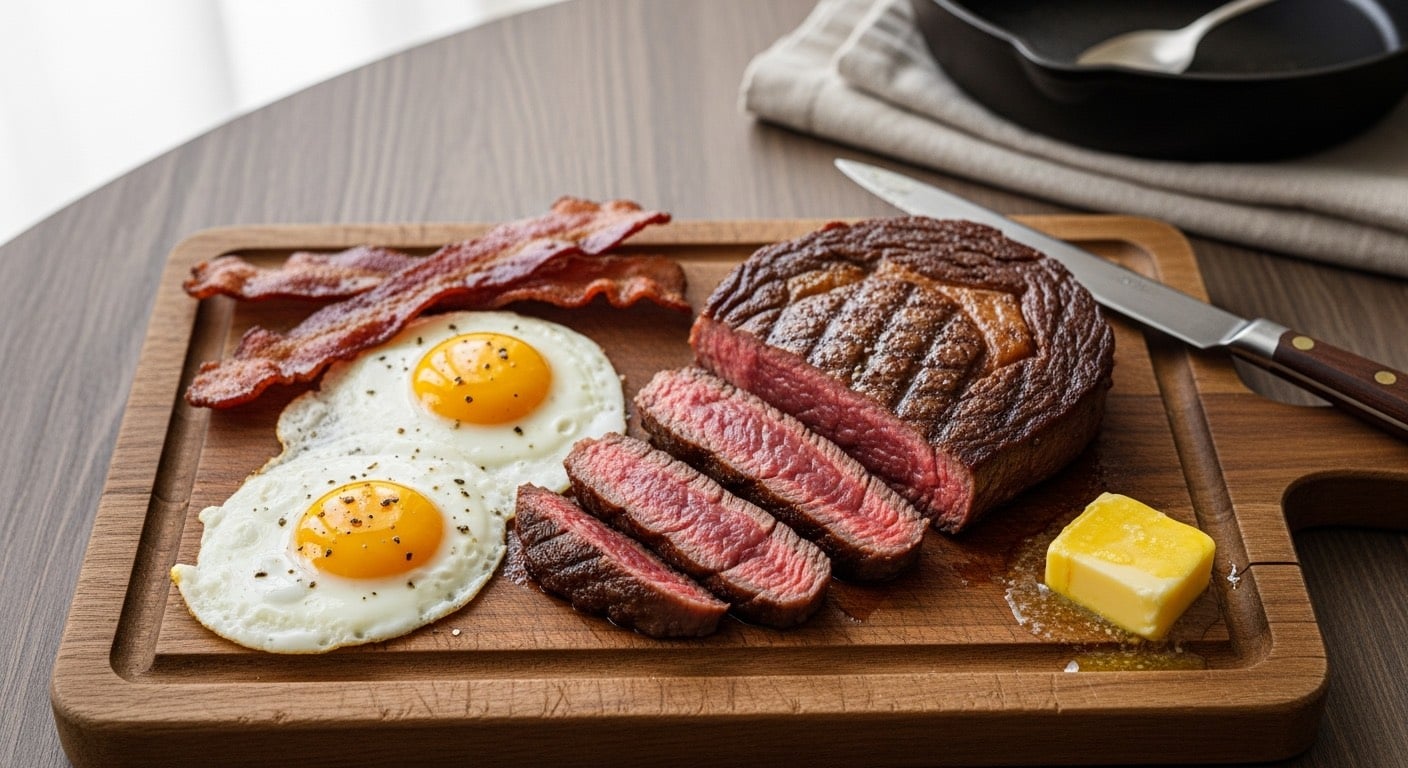
I get some version of this question almost every week from folks in my homestead and natural-health circles — usually right after someone has been eating ribeyes, eggs, and butter for a month and watched the scale drop anyway. They want to know if carnivore really lets them break the rules. So let me lay it out the way I’d explain it across my own kitchen table.
One of the biggest claims in the carnivore and low-carb world is that calories matter less when insulin is low.
You’ll hear people say things like:
“I’m eating more calories than ever, but I’m still losing weight.”
Or:
“As long as you don’t spike insulin, it’s hard to gain body fat.”
At first, that sounds like it breaks the rules of weight loss. Most people have been told their whole lives that fat loss is only about calories in versus calories out. Eat less than you burn, you lose weight. Eat more than you burn, you gain weight.
But anyone who has done carnivore for more than a few weeks knows something strange can happen.
You may eat ribeyes, eggs, butter, ground beef, bacon, and fatty meat until you are full, yet your waist still shrinks. You may stop counting calories, feel less hungry, and still lose weight. Some people even plug their food into a tracking app and see a “calorie surplus,” but the scale keeps moving down.
So what is happening?
Can you actually lose weight in a calorie surplus on carnivore?
The honest answer is this:
You probably cannot lose body fat in a true sustained calorie surplus. But carnivore can make it look like you are in a surplus when you are not, and low insulin may make fat loss easier by changing hunger, fat burning, water weight, and fuel partitioning.
That answer is not as flashy as “calories don’t matter,” but it is much closer to what the research supports.
First, What Counts as a Real Calorie Surplus?
Before we talk about insulin, we need to define the problem.
A calorie surplus means your body is taking in more usable energy than it is burning over time.
But most people do not actually know whether they are in a real surplus. They are usually estimating.
Fitness apps estimate your maintenance calories. Smart watches estimate your calorie burn. Food labels estimate calories. Your digestion, hormones, sleep, stress, movement, and metabolism all affect what happens after food goes in.
So when someone says, “I’m eating 3,500 calories on carnivore and still losing weight,” that may be true on paper. But it does not automatically mean they are in a true surplus inside the body.
They may be burning more than they think.
They may be eating less often.
They may be losing water weight.
They may be more active without realizing it.
They may be absorbing less energy than expected.
They may be building muscle while losing fat.
Or their old maintenance number may have been wrong.
This is why the phrase “calorie surplus” gets messy in real life.
Why Carnivore Can Cause Weight Loss Even When Calories Seem High
Carnivore is not magic, but it does change a lot of variables at once.
Most people who go carnivore remove sugar, grains, seed oils, processed snacks, alcohol, desserts, liquid calories, and hyper-palatable foods. That alone changes appetite dramatically.
A ribeye and eggs do not hit the brain the same way pizza, chips, cereal, soda, and dessert do.
Carnivore meals are high in protein and fat, which tend to be very filling. Many people naturally drop from constant snacking to one or two meals per day without trying. They are not white-knuckling hunger. They are simply not as hungry.
This is one of the most important reasons carnivore works for fat loss.
It often creates a calorie deficit without the person feeling like they are dieting.
That matters because a diet you can follow easily usually beats a diet that looks perfect on paper but makes you miserable.
Where Insulin Fits In
Insulin is a storage hormone. That does not mean insulin is bad. You need insulin to live. But insulin does play a major role in whether your body is storing energy or releasing energy.
When insulin is high, fat breakdown is suppressed. Your body is being told, “We have incoming fuel. Store energy. Do not release much stored fat right now.”
When insulin is low, your body has an easier time releasing stored fat and using fatty acids for fuel.
This is where low-carb, keto, and carnivore diets have a real advantage for many people.
By removing most carbohydrates, insulin levels usually come down. When insulin is lower, the body is in a better hormonal environment for accessing stored body fat.
That does not mean calories disappear.
It means the body may have an easier time tapping into its stored fuel, especially for people who are insulin resistant.
This is the part that many low-carb advocates get right.
But then some people take it too far.
They move from “low insulin makes fat loss easier” to “calories do not matter as long as insulin is low.”
That second claim is much harder to defend.
Can You Store Fat Without Spiking Insulin?
Yes.
This is the part carnivore influencers often underplay.
Insulin helps regulate fat storage, but it is not the only way your body stores dietary fat. When you eat fat, it can be packaged, transported, and stored through other mechanisms too.
In fact, dietary fat is already fat. It does not need to be converted from carbohydrate first.
So even if your insulin response is lower on carnivore, excess dietary fat can still be stored if your body does not need that energy.
That is why someone can absolutely gain weight on carnivore.
It may be harder for many people because appetite is lower and food choices are limited. But it is not impossible.
Ask anyone who has eaten unlimited heavy cream, butter, cheese, bacon, and fatty cuts while barely moving. Carnivore can still become a surplus.
The question is not, “Can fat be stored when insulin is low?”
It can.
The better question is:
Does a low-insulin carnivore diet make it easier to avoid overeating and easier to burn stored fat?
For many people, yes.
What the Research Suggests
The research supports a middle position.
On one side, insulin clearly affects fat metabolism. Insulin suppresses lipolysis, which is the release of fat from fat cells. It also supports triglyceride storage inside fat cells.
So the hormonal argument is real.
Dr. Ben Bikman has also published research connected to the carbohydrate-insulin model. One study found that a high-carbohydrate diet lowered adipose tissue mitochondrial respiration compared with lower-carbohydrate approaches. In simpler terms, diet composition may affect how fat cells handle energy. That gives some support to the idea that macronutrients can influence fuel partitioning.
But there is another side.
A tightly controlled metabolic ward study by Kevin Hall and colleagues tested an isocaloric ketogenic diet. Insulin dropped and fat oxidation increased, but body fat loss did not increase in the way the stronger insulin-only model would predict.
That matters.
It means lower insulin can increase fat burning, but that does not automatically equal more body fat loss when calories are controlled.
Another major trial, DIETFITS, compared healthy low-fat and healthy low-carb diets for 12 months. The average weight loss was similar, and baseline insulin secretion did not predict who did better on low carb.
That does not mean low carb does not work. It means insulin is not the whole story.
There is also evidence that lower-carb diets may increase energy expenditure during weight-loss maintenance, especially in people with higher insulin secretion. So again, the research does not destroy the insulin argument. It just keeps it from becoming a cartoon.
The best interpretation is this:
Insulin matters. Calories matter. Food quality matters. Appetite matters. Metabolism matters. The body is not a calculator, but it is also not free from energy balance.
Why People May Lose Weight While Eating “More Calories” on Carnivore
There are several reasons carnivore can feel like it beats calories.
1. You lose water weight first
When you cut carbs, you store less glycogen. Glycogen holds water. So in the first week or two, weight can drop fast even before major fat loss happens.
That is real weight loss, but it is not all body fat.
2. You naturally eat less often
Many people on carnivore stop snacking without trying. They may eat big meals, but fewer meals.
A huge steak dinner may feel like a lot of food, but if it replaces breakfast, lunch, snacks, dessert, and late-night eating, total intake may still be lower.
3. Protein is expensive to process
Protein has a higher thermic effect than fat or carbohydrate. That means your body uses more energy digesting and processing protein.
Carnivore is often high in protein, especially if someone is eating leaner cuts, eggs, steak, ground beef, and seafood.
4. Appetite drops
Ketogenic and very low-carb diets often reduce hunger. This is a huge advantage.
People argue about metabolism, but appetite may be the bigger lever. If carnivore makes you full enough to stop eating without tracking, it can work incredibly well.
5. Food becomes less hyper-palatable
A carnivore diet removes most foods designed to make you overeat.
No chips. No cookies. No fries. No cereal. No sugary coffee drinks. No “just one more bite” dessert.
Meat is satisfying, but it usually does not create the same binge loop as processed carbs plus fat.
6. You may move more without noticing
When blood sugar is stable and cravings are lower, some people feel more energy. They walk more, fidget more, train harder, or stop crashing in the afternoon.
That raises total daily energy expenditure.
7. Your “maintenance calories” were wrong
This is extremely common.
Someone says, “My maintenance is 2,400 calories, but I’m eating 3,000 on carnivore and losing weight.”
Maybe.
Or maybe their true maintenance is 3,200 because they are bigger, more active, training harder, or burning more than the calculator guessed.
So Can You Lose Fat in a Calorie Surplus on Carnivore?
Here is the cleanest answer:
If it is a true, sustained calorie surplus, fat loss is unlikely.
But there are exceptions that make the real world confusing.
You could lose body fat while gaining muscle, glycogen, or water. That is body recomposition. Your scale weight may stay the same or even go up while your waist gets smaller.
You could lose scale weight in the short term because of water loss or less food volume in your gut.
You could think you are in a surplus because a calculator says so, but actually be in a deficit.
You could experience higher energy expenditure, better appetite control, and better fat oxidation on carnivore, which makes fat loss easier than it was on a standard diet.
But if you consistently eat more energy than your body uses, and that extra energy is not being burned or used to build lean tissue, your body has to put it somewhere.
Often, that somewhere is body fat.
The Better Way to Think About Carnivore and Calories
Instead of asking, “Can I ignore calories on carnivore?” ask this:
Does carnivore help me control calories without counting them?
For many people, the answer is yes.
That is the real win.
Carnivore may help you lose weight because it lowers insulin, reduces hunger, improves blood sugar stability, removes trigger foods, increases protein, and simplifies eating.
That is very different from saying calories do not matter.
Calories still matter, but carnivore may make calorie control almost automatic.
That is why some people fail on a normal calorie-restricted diet but succeed on carnivore. It is not because physics changed. It is because their biology and behavior changed.
They are no longer fighting hunger all day.
They are no longer riding the blood sugar roller coaster.
They are no longer surrounded by foods engineered to override fullness.
They are eating foods that send stronger satiety signals.
That is powerful.
Practical Takeaway
If you are doing carnivore for weight loss, do not obsess over calories on day one. Give your body time to adapt. Eat meat, eggs, and animal foods until comfortably full. Focus on consistency, sleep, hydration, electrolytes, and strength training.
But if fat loss stalls for weeks, do not hide behind the phrase “insulin is low.”
At that point, calories may need attention.
The easiest adjustments are usually:
- Eat more lean protein.
- Reduce added fats like butter, cream, cheese, and rendered fat.
- Stop drinking calories.
- Prioritize whole cuts of meat over carnivore desserts or snack foods.
- Lift weights.
- Walk daily.
- Track your waist, not just the scale.
Carnivore can make fat loss dramatically easier, but it does not give you unlimited energy storage immunity.
Final Answer
Can you lose weight in a calorie surplus on carnivore?
Usually, no. Not if it is a true, sustained surplus.
But can you lose weight while eating more than you expected, feeling full, keeping insulin low, and not counting calories?
Absolutely.
That is where carnivore shines.
The best version of the insulin argument is not “calories do not matter.”
The best version is:
Lower insulin makes stored fat easier to access, carnivore makes overeating harder, and the combination can make fat loss feel almost effortless for some people.
That is not magic.
It is metabolism working in your favor — and out here, I’ll take a tool that makes eating real, whole food this simple any day of the week.
Sources & Further Reading
The science below is what shaped this article. I’d rather show my work than ask you to take my word for it.
Insulin, fat storage & lipolysis
- Insulin regulation of lipolysis and fat metabolism — pmc.ncbi.nlm.nih.gov/articles/PMC3753874
Ben Bikman & the carbohydrate-insulin model
- Bikman et al.: a high-carbohydrate diet lowers adipose tissue mitochondrial respiration — PubMed 35177807 (full text: Nature / EJCN)
- Ketogenic diet pilot study in women with type 2 diabetes (Bikman coauthor) — PMC6710763
- Dr. Ben Bikman: Glucagon’s role in fat burning — benbikman.com/glucagon-fat-burning
- Dr. Ben Bikman: Nuclear receptors, fat cells, and the hidden signals controlling metabolism — benbikman.com/nuclear-receptors-fat-cell-function
Controlled feeding & diet-comparison trials
- Kevin Hall: energy expenditure and body composition after an isocaloric ketogenic diet (metabolic ward) — PubMed 27385608 (full text: PMC4962163)
- DIETFITS: low-fat vs low-carb randomized clinical trial (12 months) — PMC5839290
- Ebbeling/Ludwig carbohydrate-insulin model trial, BMJ — bmj.com/content/363/bmj.k4583 (PubMed: 30429127)
Overfeeding & appetite
- Fat and carbohydrate overfeeding in humans (excess dietary fat stored efficiently) — PubMed 7598063
- Ketogenic diets and appetite suppression (review) — PubMed 25402637
This article is for general education and reflects my own reading of the research and time on the homestead. It is not medical advice. Talk with your own doctor before making big changes to how you eat, especially if you manage diabetes, take medication, or are pregnant or nursing.